Kenosha Epoxy Flooring brings more than 20 years of epoxy flooring work to Waukegan, and on this page we focus on the floors that take the hardest chemical abuse in the city: aircraft hangars, along with the shops and garages that share their problems on a smaller scale. A hangar slab is not a big garage. It has to shed spilled fuel toward a drain, survive aviation fluids and keep its bond at the edges where liquid collects.
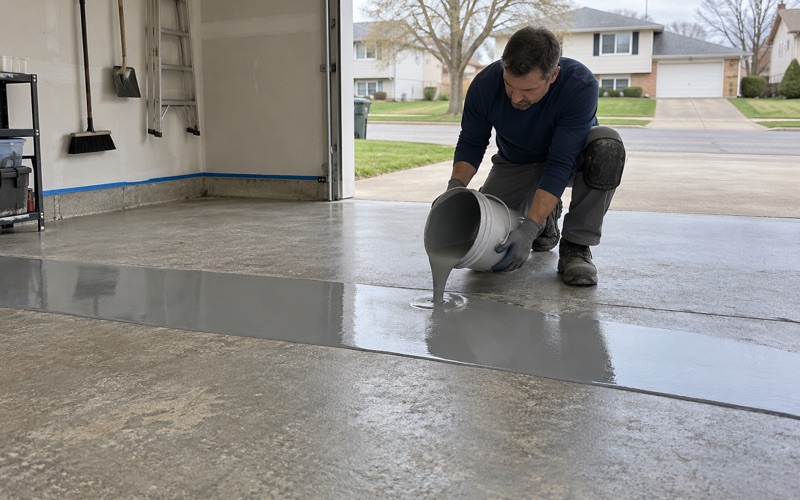
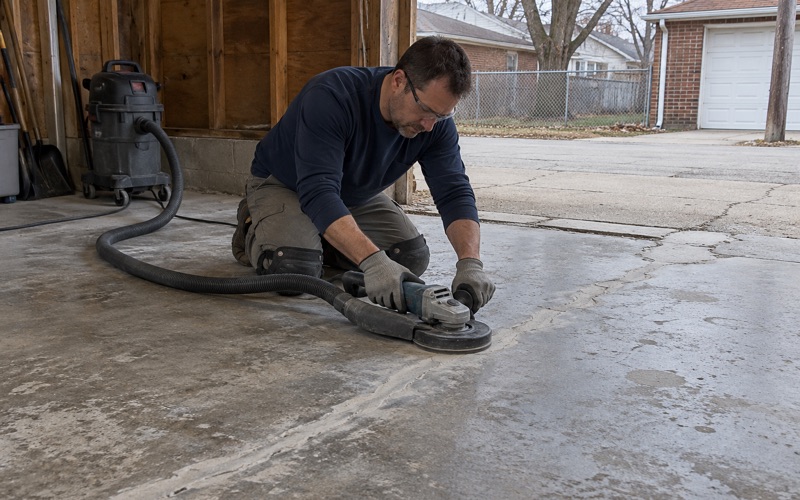
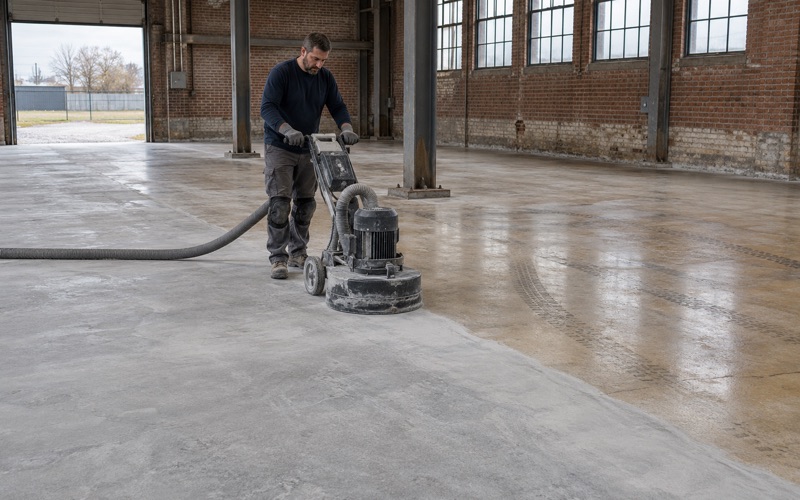
Every floor we quote starts with the same groundwork. We open the concrete mechanically with a diamond grinder or a shot blaster, never acid, and we test the slab for moisture as a written line item before anything goes down. The proposal then names the product, the system build and the finished thickness, so an owner can check what was quoted against what was applied.
We also tell owners what a coating cannot do. It is a film that follows the slab beneath it, so a cracked or shifting floor may need repair or replacement first, and we say that before quoting rather than after. Warranty exclusions get read aloud before the job is sold, with moisture named first on the list.
Hangar Floors at Waukegan National Airport
A Port District Field Inside the City
Waukegan National Airport sits inside the city limits at 2601 W Plane Rest Drive and is owned by the Waukegan Port District. The field lists 188 based aircraft and a 6,000-foot runway, and it dispenses over 3 million gallons of aviation fuel a year. That much fuel moving through one airport means a lot of hangar floors that see drips, overfills and wash-down runoff.
On October 1, 2026 the Port District took over the field’s lone fixed base operation from Signature Aviation, which had run it for about a decade, and rebranded it North Shore Jet Center. The airport director tied the change to a goal of supporting investment in improved general aviation facilities. For hangar owners and tenants, that makes this a reasonable moment to look hard at the floor under the aircraft.
Private and Corporate Hangar Tenants
The airport states it has infrastructure in place to accommodate large corporate jet hangar sites, alongside the private hangars that house smaller aircraft. Those two tenant types ask very different things of a floor. A corporate jet hangar may host maintenance, tug traffic and heavy main gear loads, while a private hangar might see a single owner doing oil changes and routine inspections.
We scope each one on its own terms. A private owner may need a durable, cleanable surface that tolerates oil and the odd fuel drip, while a corporate tenant usually needs a full fluid-resistant system with defined drainage edges. Either way, we start by walking the floor, reading the cracks, joints and any old coating, and telling the owner plainly what the slab needs.
Why a Hangar Is Not a Big Garage
A garage floor mostly fights tire wear, hot tire pickup and whatever the car drags in. A hangar floor has to do that and also stay intact under Jet-A, hydraulic fluid, cleaning solvents and the foam and water a fire system may discharge. The chemistry is harsher, and a failed edge means fuel seeping under the film instead of running to the drain.
That difference drives every decision downstream, from surface profile to topcoat. A coating chosen because it looked good in a showroom garage can soften, stain or lift once aviation fluids sit on it. We would rather explain that up front than put a garage system on a floor it was never rated for.
Looking for epoxy-flooring closer to Gurnee? See Epoxy-Flooring Services in Gurnee.
Pitched to the Trench Drain Under NFPA 409
Floor Pitch and the Trench at the Doors
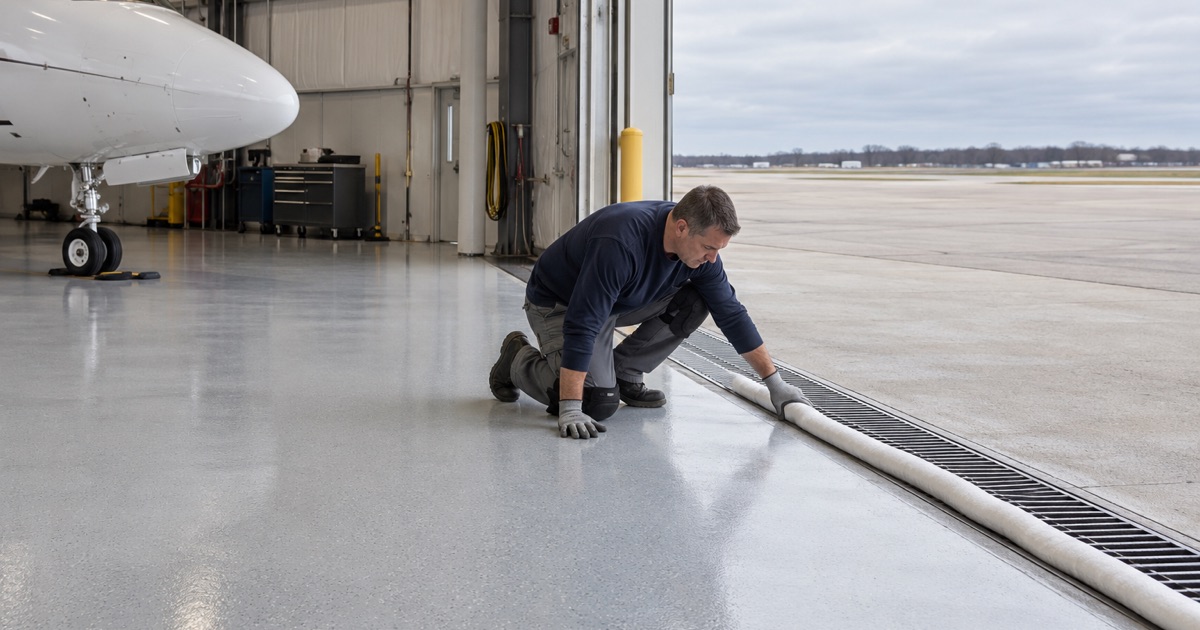
NFPA 409, the fire protection standard for aircraft hangars, ties floor pitch, trench drains and curbs together for one purpose. The drainage arrangement has to restrict the flow of spilled fuel and collect, contain and dispose of fuel, foam and water. In practice a trench drain typically runs parallel to the hangar doors, so a spill is caught before it reaches the apron.
The standard addresses drainage, not the brand of coating on top of it. What it means for the floor system is that the slab is deliberately sloped, and anything applied to it has to respect that slope rather than fill it in. A thick self-leveling build that flattens the pitch near the doors works against the whole drainage design.
Carrying the Coating Into the Trench Edge
The trench edge is where hangar coatings usually fail first. Fuel and wash water concentrate there, the concrete lip often carries old patching, and any gap between film and grate frame becomes a path for liquid to get under the coating. Once fluid is working beneath the film, the bond loosens from the drain outward.
We grind the trench lip and the frame edges to the same profile as the open floor, within the ICRI CSP range the product sheet calls for. The coating is then terminated into the trench edge cleanly, with the edge detailed rather than feathered thin. The goal is a continuous film that delivers spilled fluid into the drain instead of letting it creep underneath.
Joints, Curbs and Cracks Along the Way
A hangar slab is cut into large panels, and every joint between the field and the trench is another place fluid can settle. We fill control joints with a semirigid filler before the coating goes over them, so tug wheels and aircraft tires do not break the edges down. Moving cracks are read and treated first, because a film will follow them regardless.
Curbs and wall bases need attention too, since containment depends on liquid staying on the floor and moving toward the trench. We carry the system up onto curb faces where the scope calls for it and seal transitions so wash water cannot find an open corner. Where a slab needs real repair, we say so before the quote is signed.
Coatings Rated for Jet Fuel and Hydraulic Fluid
What Aviation Fluids Do to a Garage Epoxy
Jet-A is a kerosene-type fuel, and the hydraulic fluids used in aircraft are aggressive toward many resins. A general garage epoxy carries no rating for either, and on a hangar floor that shows up as softening, staining or a gloss that dulls wherever drips sit. A thin single-coat kit can also leave weak spots where fluid reaches bare concrete.
Hangar floor systems are sold specifically on resistance to aviation fluids. Sikafloor MultiDur HS names Jet-A and Skydrol, Flowcrete Flowcoat SK names Skydrol, and Tnemec’s aviation literature pairs an epoxy base with a chemical-resistant urethane topcoat. Skydrol is mainly a transport-category fluid, so the right rating depends on what actually lives in a given hangar.
Building a Fluid-Resistant System
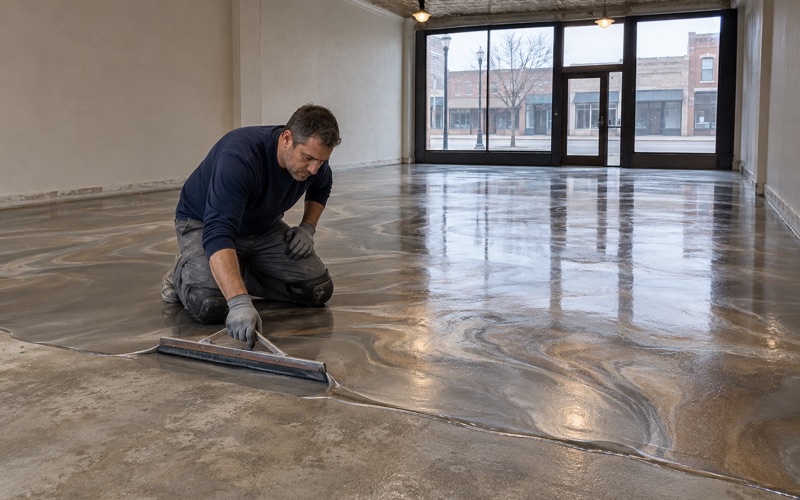
For a hangar we typically build up from a penetrating primer into a 100% solids epoxy body coat, sometimes with a quartz aggregate broadcast for traction where tugs and crews work. The finish is a chemical-resistant topcoat chosen against the fluid list for that hangar, whether urethane or polyaspartic, rather than whatever is quickest to apply. Every layer and its thickness is written into the proposal.
Traction matters more on a hangar floor than most owners expect, because a fluid-wet coating is slick underfoot. We set broadcast density so crews can work safely while the surface still cleans and squeegees toward the trench. That balance is part of the system build we name, not an afterthought added on application day.
Moisture Testing Before Any Fluid Rating Matters
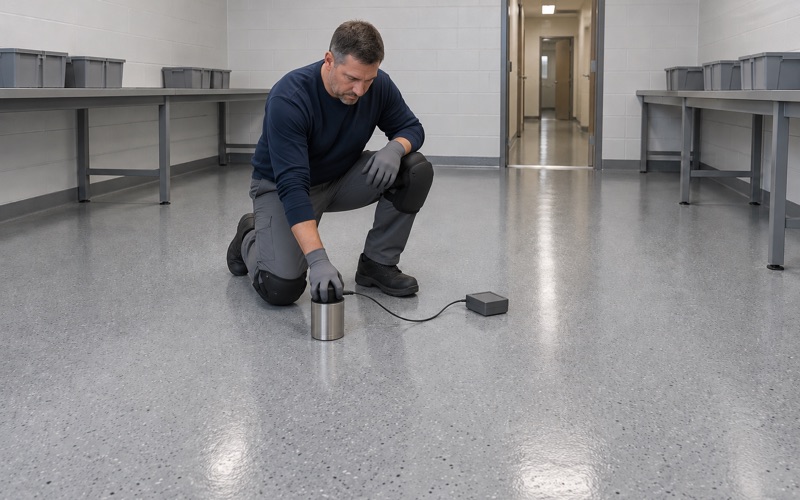
A coating rated for Jet-A still fails if the slab under it pushes moisture up against the bond. That is why moisture testing is a line item on every scope, using ASTM F2170 in-situ relative humidity probes or ASTM F1869 calcium chloride testing depending on the slab. Where readings run high, a moisture-mitigation primer goes into the build before the fluid-resistant layers.
We also schedule cure against slab temperature and the dew point spread at the slab surface rather than the calendar. Applying over a slab near its dew point invites amine blush and a weak topcoat bond. In a large unheated hangar, that sometimes means waiting for warmer conditions, and we say so plainly when it applies.
Planning a Hangar, Shop or Garage Floor in Waukegan
Shop and Garage Floors in the City
Not every Waukegan floor sits on the airfield. Workshops, maintenance bays and home garages call for the same principles on a smaller scale: a mechanically profiled slab, a moisture test, and a system matched to what will spill on it. A shop that handles oils and solvents may still benefit from a urethane or polyaspartic topcoat over a 100% solids epoxy base.
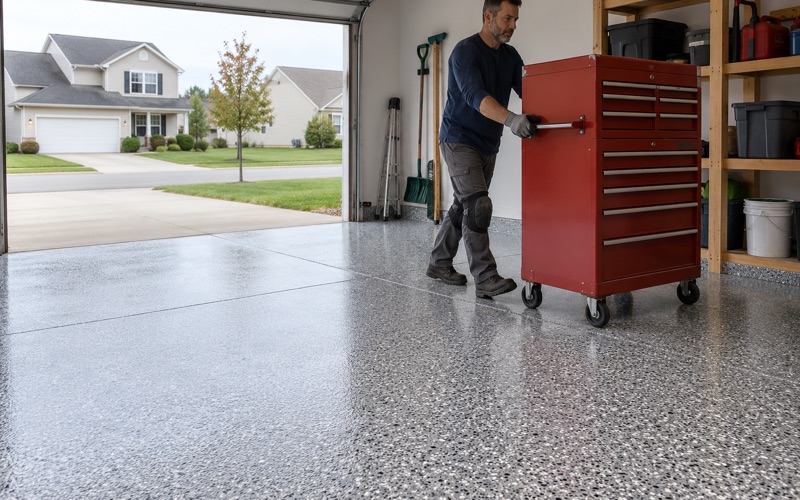
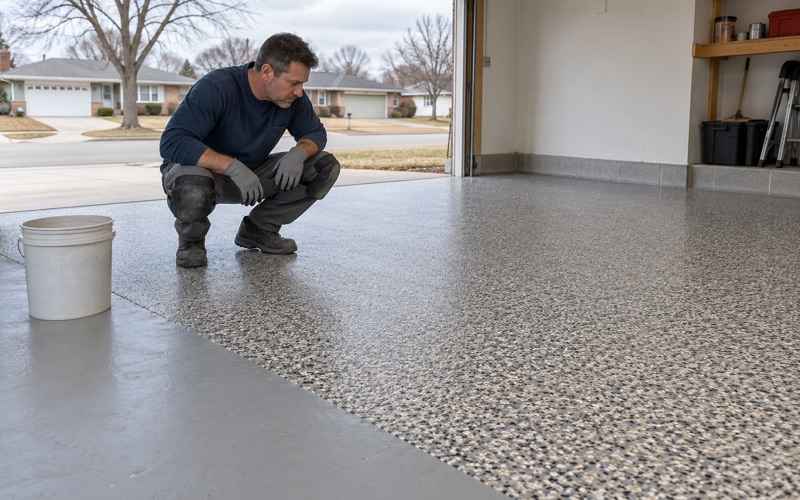
For a home garage, a vinyl flake broadcast with a polyaspartic topcoat is a common build that resists hot tire pickup and cleans easily. We hold the same rules there as in a hangar, with no acid etch and a proposal that names the products and thickness. A homeowner gets a written contract before any deposit is taken, with the warranty terms spelled out in it.
Scheduling Around Hangar Operations
An occupied hangar cannot simply be closed for a week. Aircraft have to be moved, tenants have to be told, and maintenance has to pause. We plan the work in phases where the layout allows it and use overnight and weekend windows where the owner needs the building back fast, the same way we schedule plant and shop floors.
Dust control matters on an airfield. Grinding dust and slurry are collected on site and never washed toward a drain, which on a hangar floor matters doubly because the trench feeds a containment system designed for fuel and foam, not concrete fines. We leave the trench as clean as we found it.
What We Check Before Quoting
Before quoting a Waukegan hangar, shop or garage, we walk the slab and look at the pitch toward any drain, the condition of the trench edge, the joints and any old coating. We note whether earlier paint or sealer will have to be ground off completely. Each of those findings shows up in the written scope.
If a slab needs repair before it can be coated, we tell the owner directly. If the floor is sound and the fluids are known, the proposal lists the primer, body coat, topcoat and finished thickness, so a hangar tenant or building owner can check the result against the quote. That is the whole job, written down before it starts.
- 20+ Years on Concrete
- Moisture Tested First
- Written System Proposals