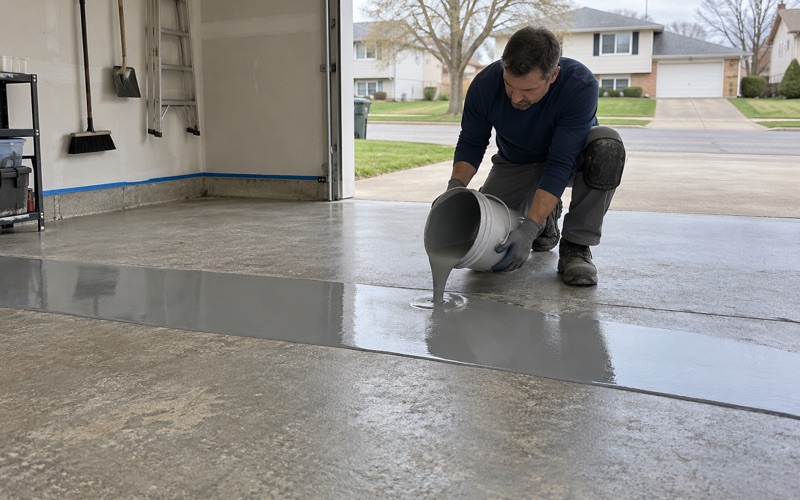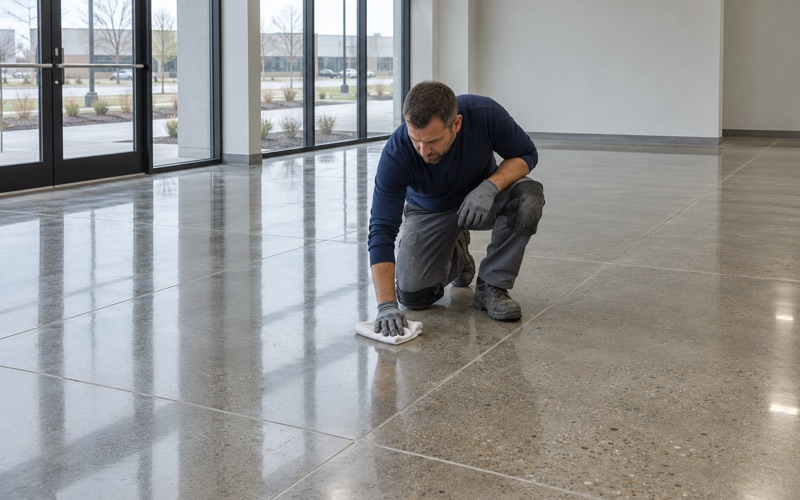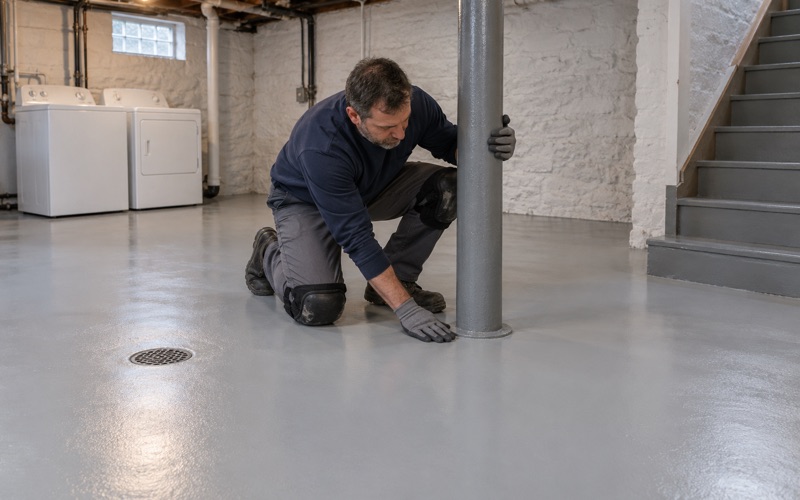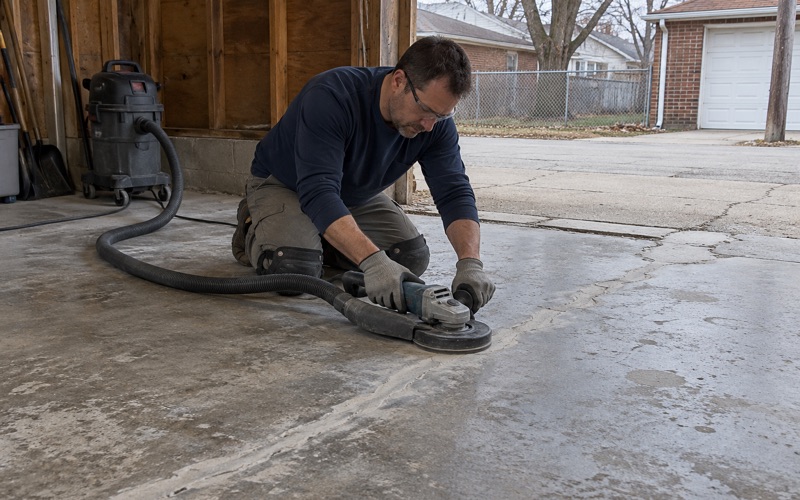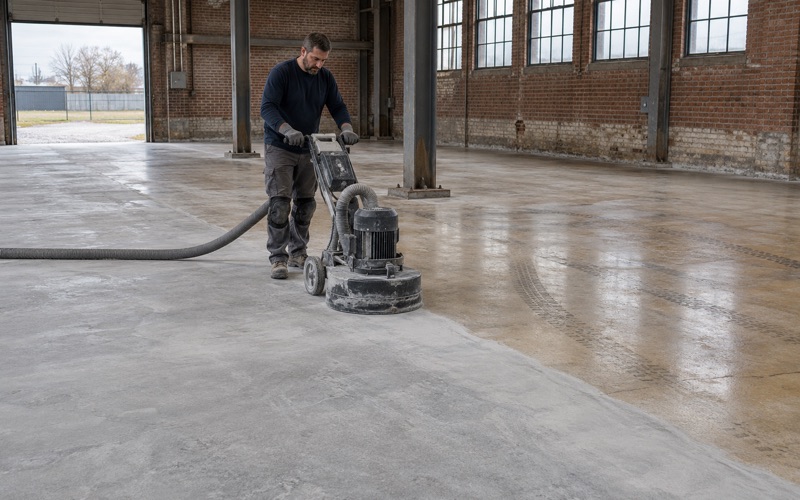
Kenosha Epoxy Flooring has spent more than 20 years on epoxy flooring in Sturtevant and across our service area, and the floors we are asked about here tend to split two ways. Some are machine-shop and fabrication floors that stay wet with coolant; others are home garages that take a full winter of salt. Both start the same way, with a slab opened by a diamond grinder or shot blaster, never by acid.
Before we price anything, we walk the floor and read it. Cracks, sawcut joints and any old coating tell us whether the slab can take a coating as it is, or whether it needs repair or replacement first, and we say which plainly. A coating is a film that follows the concrete under it. It will not stop a slab from moving, and we tell you so before the job.
Our proposals name the product, the system build and the finished thickness, so the floor that goes down can be checked against the one that was quoted. Moisture testing sits in the scope as its own line rather than as an upsell after a blister appears, and the warranty exclusions are read aloud before you sign, with moisture first on that list.
Machine Shops, Coolant and the Floor Rule
Training and Production in the Renaissance Business Park
Sturtevant’s Renaissance Business Park is where much of the village’s machining happens. Gateway Technical College’s SC Johnson iMET Center at 2320 Renaissance Boulevard trains students in CNC machining, industrial robotics, welding, metal fabrication and automated manufacturing systems. A nearly 18,000-square-foot addition that opened in February 2013 brought the building to 61,000 square feet.
We have no claim to that building’s floors, and we mention it for a different reason. The work taught there is the work done in shops across the area, and it shapes what a shop floor has to survive. Manufacturing is a real employer base in the village, with Andis Company named among Racine County’s leading employers, and floors like these carry production every shift.
How CNC Machining Coolant Reaches the Slab
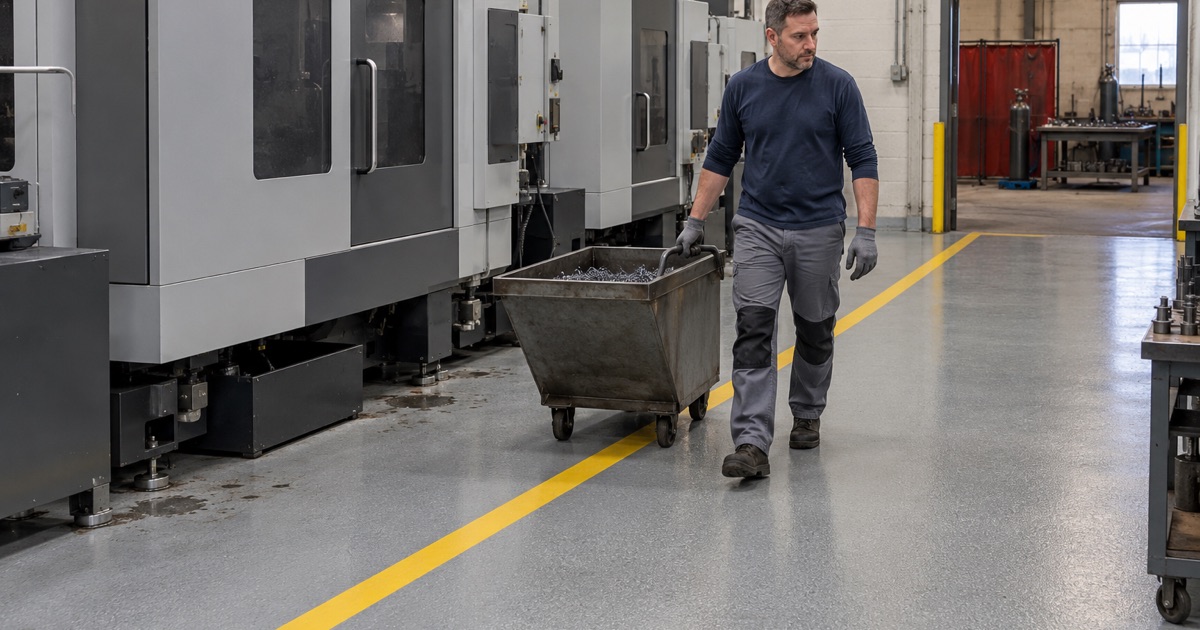
Water-miscible coolant does its job inside the machine enclosure, but some of it always leaves. It drips from chips pulled out of the machine, from parts set on a cart and from a door seal that has seen better years, and it settles as mist around the machine footprint. Over months, a bare or poorly sealed slab under a CNC machine darkens and stays slick.
Bare concrete takes that coolant in, and an oil-soaked slab is a hard surface to bond a coating to later. That is one reason we grind rather than etch. A diamond grinder or shot blaster removes the contaminated top layer and leaves a surface profile we can match to the ICRI CSP range the system calls for, where acid reacts only with what it reaches and leaves residue behind.
What OSHA 1910.22(a)(2) Says About Wet Floors
Federal OSHA covers private employers in Wisconsin, since the state runs no plan of its own for them. Under 29 CFR 1910.22(a)(2), each workroom floor is to be kept clean and, to the extent feasible, dry. Where wet processes are used, drainage must be maintained and, to the extent feasible, dry standing places such as false floors, platforms and mats provided.
That obligation belongs to the employer, and no coating makes a shop compliant on its own. What a floor system can do is support the housekeeping the rule asks for: a sealed surface that does not wick coolant, a texture that keeps footing when a spill has not yet been cleaned, and a finish that makes leaks easy to see. We build toward that and do not label the result as anything more.
Looking for epoxy-flooring closer to Winthrop Harbor? See Epoxy-Flooring Services in Winthrop Harbor.
Building the Machine Aisle: Texture and Topcoat
Slip-Resistant Broadcast Where Operators Stand
Smooth, glossy epoxy is easy to clean and slippery with a film of coolant on it. In the machine aisles and at each operator station, we broadcast aggregate into the wet coat so the cured floor carries a texture, then lock it in under the topcoat. Quartz aggregate is our usual choice for a working shop, sized to the footing that aisle needs.
Texture is a trade-off, and we set it zone by zone. A heavier slip-resistant profile at the machines grips better but holds more chips and takes more effort to mop, so traffic lanes and storage areas often get a finer texture. We mark the zones on the layout before work starts, so the shop sees exactly where each finish lands.
Reading the Chemical-Resistance Chart Against Your Coolant
Coolants differ in concentrate, additives and the cleaners used alongside them, and a topcoat that shrugs off one may soften or stain under another. Before we specify, we ask for the product names of the shop’s coolant and its cleaners, then read the coating supplier’s chemical-resistance chart against them. Where the chart is silent, we test a sample panel rather than guess.
The usual build for a wet aisle is a 100% solids epoxy body coat over a primed, ground slab, with a chemical-resistant topcoat on top, and the proposal states each layer and the finished thickness. Polyaspartic and polyurea topcoats wear well and cure quickly, but their resistance varies by product, which is why the chart decides and the label on the pail does not.
Scheduling Around Production
Most shops cannot stop for a week. We schedule plant and shop floors around the hours a building has to keep running, including overnight and weekend windows, and phase a large floor so some machines stay in production while others are moved off the slab. Cure time is set by slab temperature and the dew point spread at the surface, not by the calendar.
Grinding dust and slurry are collected on site and never washed toward a street drain or the lake. In a machine shop that matters twice over, because the old slab often carries years of coolant and oil in its top layer, and none of that should leave the building in rinse water.
Weld Bays Need a Separate Plan
Hot Spatter on a Resin Floor
Welding and metal fabrication, both taught at the iMET Center, put hot spatter on the floor every working day. Molten droplets land on a resin surface hot enough to mark, pit or burn it, and grinding sparks add to the load. A glossy finish in a weld bay will not keep its first-day look for long.
That makes a weld bay a decision about heat rather than appearance. We talk it through with the shop before the layout is drawn, because the right answer depends on how much welding happens there, how the bay is screened, and what the owner expects the floor to look like after a year of use.
Protected Zone or Sacrificial Zone
There are two honest options. A protected zone keeps the coating continuous and relies on welding blankets, mats or screens where spatter falls, which means the shop has to maintain those covers. A sacrificial zone accepts marking as part of the work, with a plain, recoatable system laid down so the bay can be ground and recoated on a schedule.
Either way, we write the choice into the proposal and the warranty exclusions, so nobody is surprised later. Spatter burns in a bay the owner chose to run unprotected are wear, not a failure of the system, and we would rather say that before the job than argue it afterward.
Garage Floors in Sturtevant Homes
A Village of Owner-Occupied Detached Houses
Away from the business park, Sturtevant is mostly owner-occupied homes. Census figures count 1,568 owner households among 1,914 housing units, and 1,324 of those owners live in detached houses. Most homes were built after 1960, with the largest share from 2000 to 2009, so many garages here sit on slabs of that era or newer.
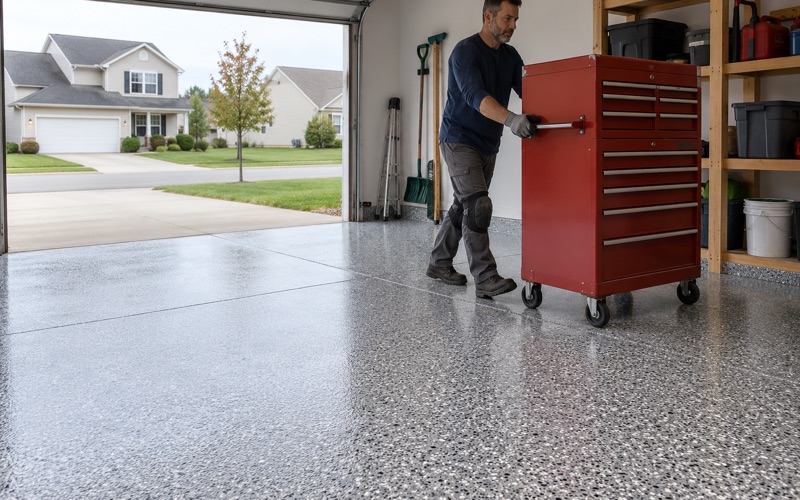
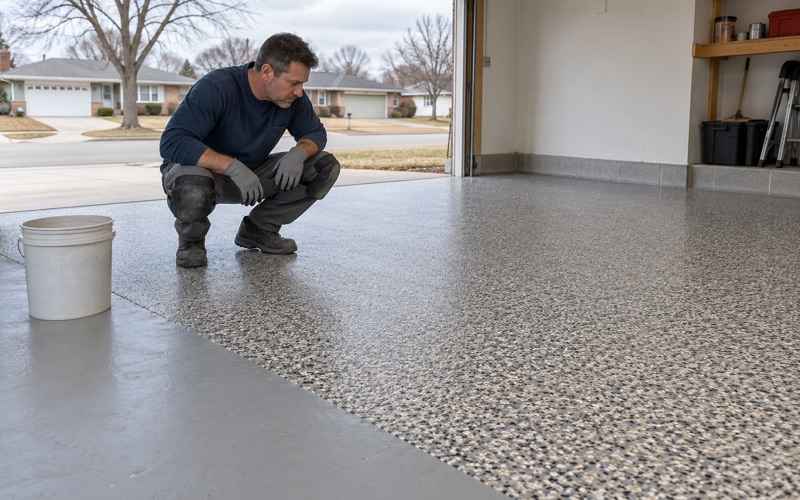
A garage floor in Sturtevant gets the same winter as one in Kenosha: road salt and calcium chloride brine ride in on the tires and sit on the slab for months. We build garage systems for that, typically a 100% solids epoxy base with a vinyl flake broadcast and a polyaspartic topcoat, and the proposal names each layer and its thickness.
Testing the Slab Before Coating
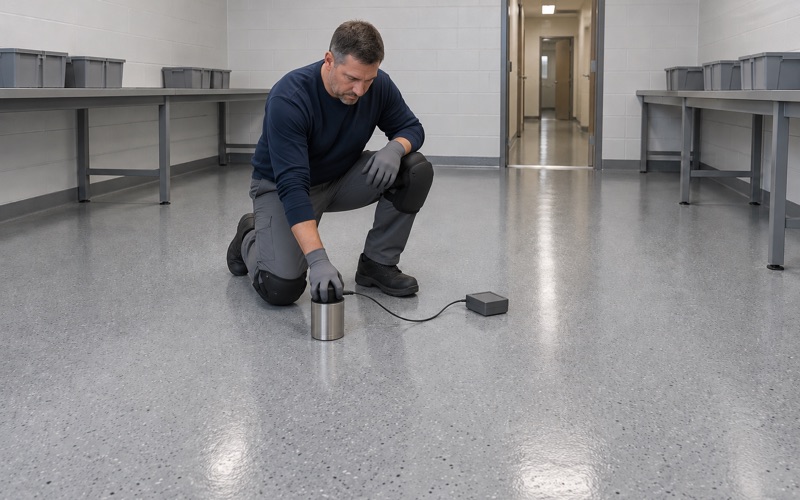
The Wisconsin Uniform Dwelling Code calls for a 6-mil vapor retarder under new dwelling slabs, but SPS 322.38(3) does not require one under an unconditioned attached garage slab. A garage floor that looks dry can still push moisture up into a coating, which is why we test before we coat, using ASTM F1869 calcium chloride kits or ASTM F2170 relative humidity probes.
Cold matters too. An unheated garage slab in a Racine County winter can sit too close to the dew point for a coating to cure properly, and when it does, we say the job waits for spring rather than risk amine blush or a soft film. The schedule follows slab temperature, not the date on the calendar.
Contracts, Permits and Who Inspects
Every home job gets a written contract before any deposit is taken, as Wisconsin’s ATCP 110 home improvement rule requires, with the products and any warranty written into it, along with the lien-rights notice state law calls for. Wisconsin issues no license for floor coating, so we confirm with the village whether a given job needs a permit before it is scheduled.
The Village of Sturtevant has used SAFEbuilt for building inspection since January 2021, and permits come through the village website or the office at 2801 89th Street. If a project reaches past the garage floor to a driveway apron or sidewalk, the village permit table says those are inspected by Public Works staff.
- 20+ Years on Concrete
- Moisture Tested First
- Written System Proposals