Kenosha Epoxy Flooring has spent more than 20 years on epoxy flooring in Round Lake and across the state line, and much of what we install goes over concrete that has to stay dry and easy to read. A coated slab is one continuous film, so water that lands on it sits on top rather than working down into a backing. That single property shapes how we talk about floors in buildings that watch closely for leaks.
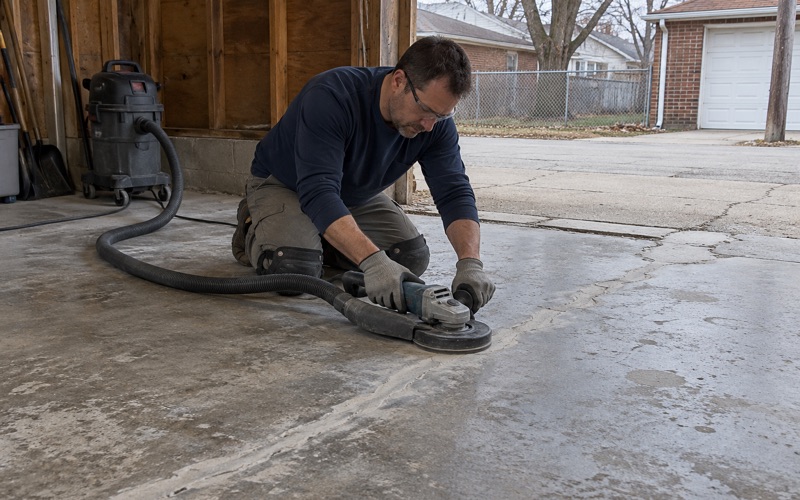
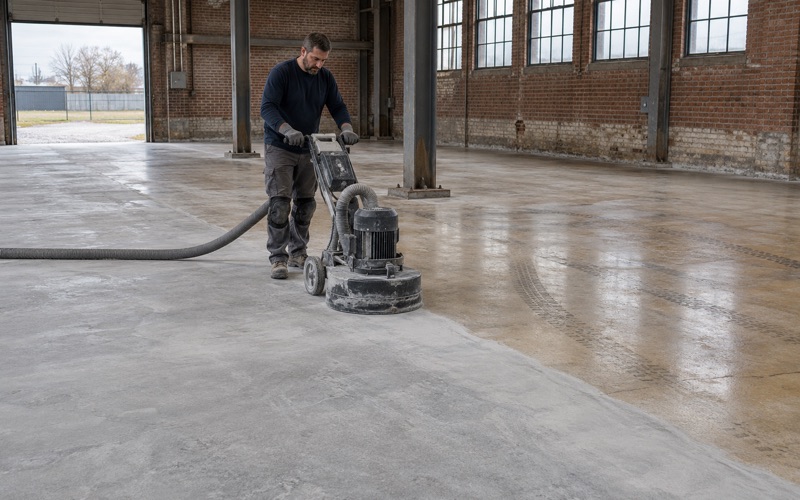
Every slab we coat is opened mechanically with a diamond grinder or shot blaster, and we never acid etch. Moisture testing appears in the scope as its own line, whether the slab sits under a basement, a garage or a commercial room. The proposal also names the product, the system build and the finished thickness, so an owner can check the floor against the quote.
Before any price, we read the cracks, joints and any old coating, and we say plainly when concrete needs repair or replacement first. A coating is a film that follows the slab beneath it, so it will not stop movement, and we tell owners that up front. Warranty exclusions are read out before the job is sold, with moisture named first.
A Library That Tested Its Air Before It Changed Its Floor
What Happened at 906 Hart Road
The Round Lake Area Public Library at 906 Hart Road offers a useful public example of a floor decision run through an indoor-air process. In January 2026 its board received an indoor air quality report from Midwest Environmental. The report stated that all mold levels were within the norm or below.
The building opened in 1988, and a remodel in 2000 and 2001 doubled its patron space. By early 2026 the library was preparing a whole-building carpet replacement. It did not simply order new flooring; it had the air sampled beforehand and again while the work was underway.
What the Report Asked Staff to Do
The Midwest Environmental report made no recommendation on temperature or humidity. What it asked was simple: staff should keep up good housekeeping and report any uncontrolled water. That request is how a public building keeps mold levels low, and it puts the floor squarely in the middle of the question.
A leak that someone sees gets reported, and a leak nobody notices does not. In a building where staff are told to watch for uncontrolled water, the floor finish decides how visible a spill or drip will be. That is a practical matter of maintenance, not a verdict on any one material.
The Library’s Choice Was Its Own
The library chose carpet again, and that was its decision to make. The project finished in mid-March 2026, ahead of an early-to-mid-April estimate, with the carpeting portion $11,400 under budget. Patrons told the board they feel good about their kids sitting on the floor now.
We mention the library because it is a clear local record of questions a facility manager may face when a floor gets wet. It is not a customer of ours, and nothing about its floor is a defect. A children’s area on carpet is a reasonable call, and a different room with a different job can reasonably land somewhere else.
Looking for epoxy-flooring closer to Burlington? See Epoxy-Flooring Services in Burlington.
Uncontrolled Water and the 24-to-48-Hour Clock
What EPA’s Mold Guide Says
The EPA publication Mold Remediation in Schools and Commercial Buildings treats water damage as a job to finish within 24 to 48 hours. Its general guidance is to clean and dry wet or damp spots within 48 hours. Its response table then breaks the drying work out by material, and the floor rows differ sharply.
For carpet and backing, the guide calls for removing water with an extraction vacuum, lowering humidity with a dehumidifier and speeding the drying with fans. For concrete, it calls for extraction followed by dehumidifiers, fans or heaters. For a hard floor such as vinyl or tile, it says to wipe, let it dry and confirm the underflooring is dry.
Why the Clock Matters in a Public Building
A window of 24 to 48 hours starts when the water arrives, not when someone notices it. On a floor that hides moisture, part of that window can pass before anyone knows there is a problem. On a floor that shows water plainly, the clock and the response can start together.
That gap is the real difference between floor types after a leak. It is not about which surface looks cleaner on a dry day. It is about how quickly staff can see uncontrolled water, report it and get it off the floor before the drying window closes.
What a Coating Does Not Do
No floor coating stops mold, and none fixes an indoor-air problem. A coated slab does nothing about where the water came from, whether that is a roof, a pipe or a window. If the source keeps running, the water keeps arriving, and any floor will be wet again.
What a coating changes is cleanup time and visibility. We describe it that way in every proposal, because overselling a floor is how owners end up disappointed. The honest claim is narrow: water stays on top, where it can be seen and wiped.
Carpet, Bare Concrete and a Coated Slab After a Spill
Textile Floors Hold Water Out of Sight
Carpet absorbs water into the pile and the backing, and from above it can look nearly dry while the backing stays wet. That is why the EPA table asks for extraction, dehumidifiers and fans rather than a simple wipe. It is a drying job with equipment, not a mop job.
None of this makes carpet wrong for a reading room or a children’s corner. Comfort, sound and warmth are real reasons to choose it. The trade-off is that after a leak, cleanup involves more steps and more hours before anyone can be sure the floor is dry.
Bare Concrete Is Porous Too
An uncoated slab is not a sealed surface. Concrete takes on water through its pores, and the EPA guide treats it as something to extract and then dry with dehumidifiers, fans or heaters. A bare floor in a back room or storage area can stay damp longer than it looks.
Bare concrete also stains, dusts and holds spilled liquids near its surface. A lithium silicate densifier hardens the top and cuts dusting, but it does not form a continuous film. For a room where water needs to stay on top, a full coating system does more.
A Seamless Coated Slab Keeps Water on Top
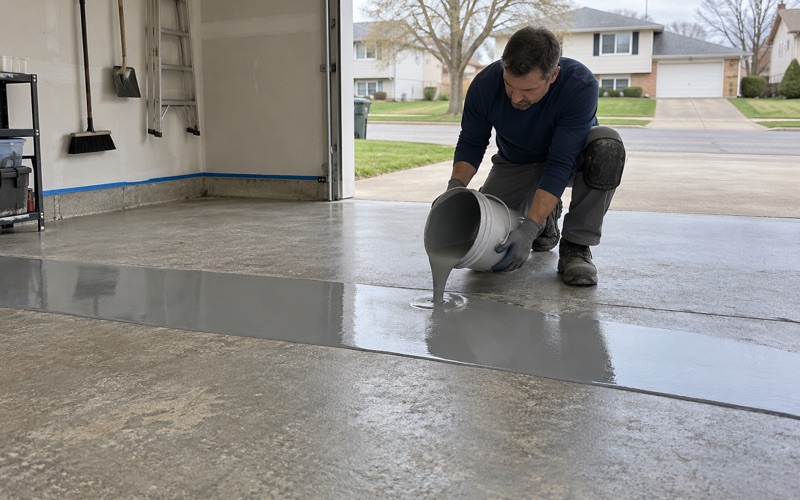
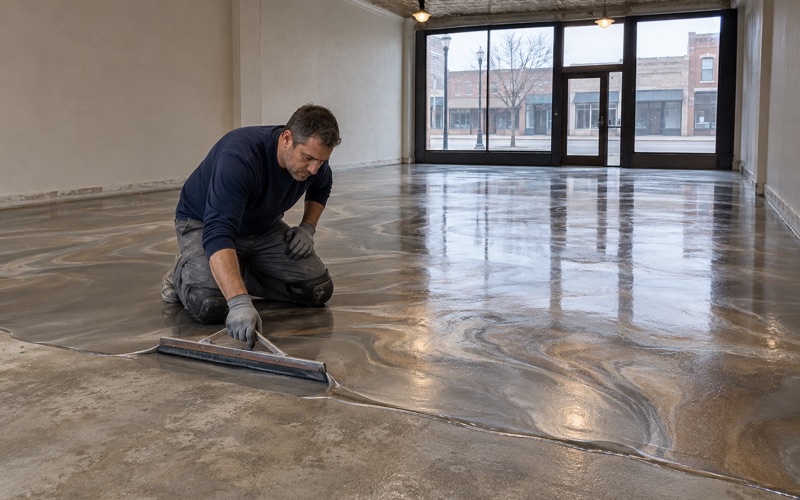
A 100% solids epoxy system, ground to the right ICRI CSP profile and finished with a polyaspartic or polyurea topcoat, forms one continuous surface with no seams. A spill or drip sits on that surface where staff can see it. It can be squeegeed, wiped and checked the same day.
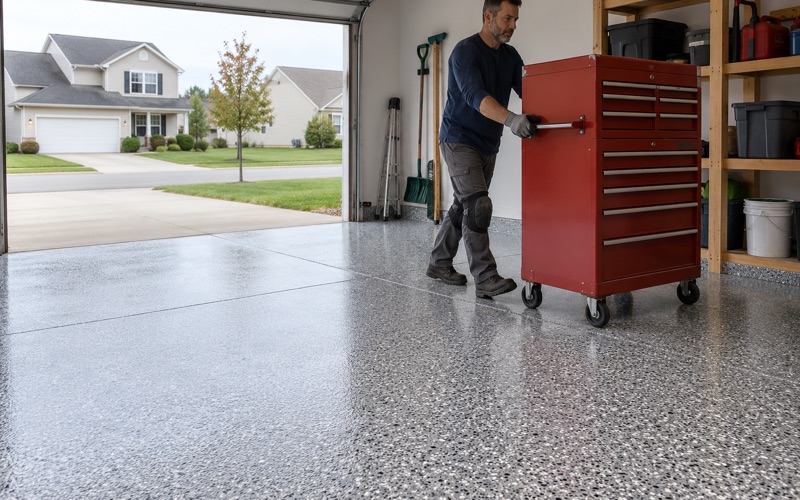
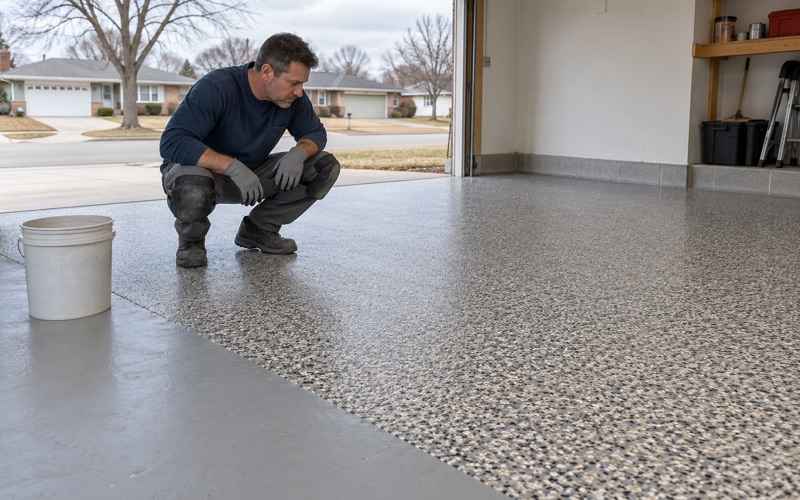
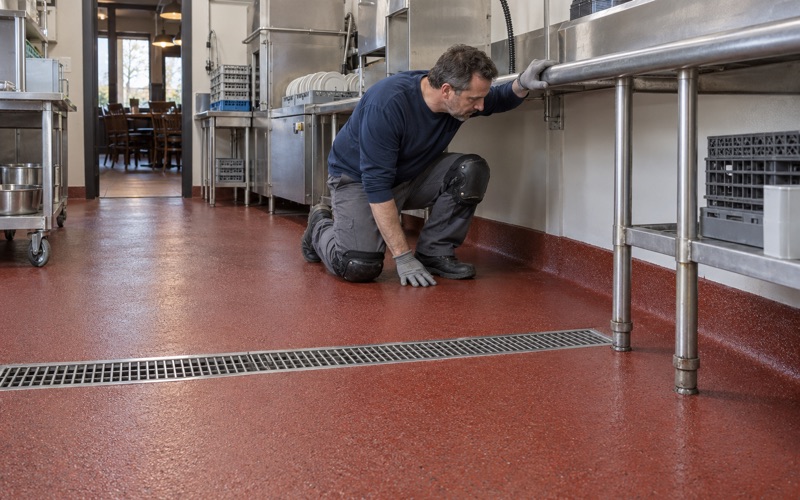
Where a floor meets a wall or a drain, the details matter as much as the open field. We carry the coating to those edges so water does not find a gap. A quartz aggregate broadcast adds traction where wet floors are expected, while a vinyl flake finish suits rooms where looks count more.
Floor Work in a Building That Stays Open
Planning Around Public Hours
The library’s carpet project showed how a public building can keep serving people while its floor changes. Staff prepared to switch to remote services and work offsite, with every attempt made to minimize complete closures. Youth Services was reportedly done in two parts rather than all at once.
We plan coating work the same way for offices, shops, kitchens and public rooms in Round Lake. Floors are scheduled around the hours a building has to keep running, including overnight and weekend windows. Work can proceed room by room or in halves so part of the building stays usable.
Testing Before the Coating Goes Down
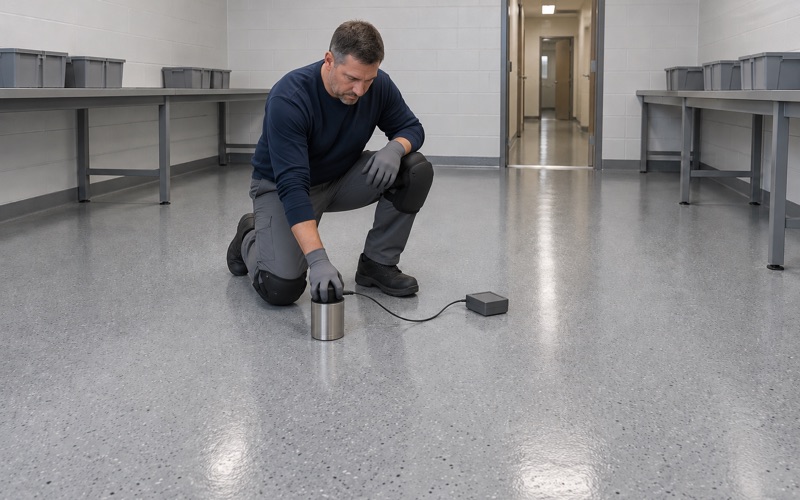
Any slab that has seen water needs its moisture checked before it is coated. We use ASTM F2170 in-situ relative humidity probes, ASTM F1869 calcium chloride testing or an ASTM D4263 plastic sheet test, depending on the slab and the system. Where readings run high, a moisture-mitigation primer goes into the scope.
Curing is scheduled against slab temperature and the dew point spread at the surface, not the calendar. Grinding dust and slurry are collected on site and never washed toward a drain. Because the proposal states the system and its thickness, the finished floor can be checked against what was promised.
Which Village, Which Permit
Round Lake Beach, Round Lake Park and Round Lake Heights are separate villages that share the Round Lake name. Each of those villages issues its own permits. We check the address against a geocoder before assuming which building department applies.
For a job inside the Village of Round Lake, that office is the Building Department at 442 N. Cedar Lake Road. Illinois licenses no general, flooring or coatings contractor, so we confirm with the village whether a permit is needed before work is scheduled. Illinois also limits the VOC content of coatings an installer may apply, and we choose products to fit.
- 20+ Years on Concrete
- Moisture Tested First
- Written System Proposals