Kenosha Epoxy Flooring installs polyaspartic floor coatings in Kenosha, WI, serving surrounding cities including Somers, Pleasant Prairie, Bristol, Sturtevant and Winthrop Harbor. In more than twenty years on concrete floors we have watched coating chemistry change, and polyaspartic is the change that matters most for garages and fast-turnaround commercial floors in a climate with long winters and hot summer tires.
Polyaspartic is a type of aliphatic polyurea. It cures quickly, stays clear rather than yellowing in sunlight, and holds onto the floor when a hot tire rolls across it. Those traits make it an excellent topcoat over an epoxy base and, on the right slab, a full system in its own right.
What polyaspartic does not do is make up for bad preparation. Because it cures so fast, it gives an installer less time to work and no forgiveness on a dirty or damp slab. Every polyaspartic floor we install starts with mechanical grinding and a written moisture test, and the proposal names the product, the system build and the finished thickness.
How Polyaspartic Floor Coating Works
Fast Cure and Short Pot Life
Polyaspartic coatings cure in a fraction of the time an epoxy takes, which is what makes a floor usable sooner. The same speed means the material has to be mixed in small batches and spread quickly, by a crew that has done it many times. Rushed or overmixed batches leave lap marks and thin spots.
We plan the layout before mixing, so each batch goes down within its working time and the wet edge is kept moving. On large floors that means more installers working in sequence rather than one person racing a bucket.
Ultraviolet Stability and Color
Standard epoxies amber when sunlight reaches them, which shows up first in the strip of floor inside a garage door. Aliphatic polyaspartic topcoats resist that yellowing, so colors and flake blends stay truer over time. That makes polyaspartic the topcoat we prefer anywhere a floor sees daylight.
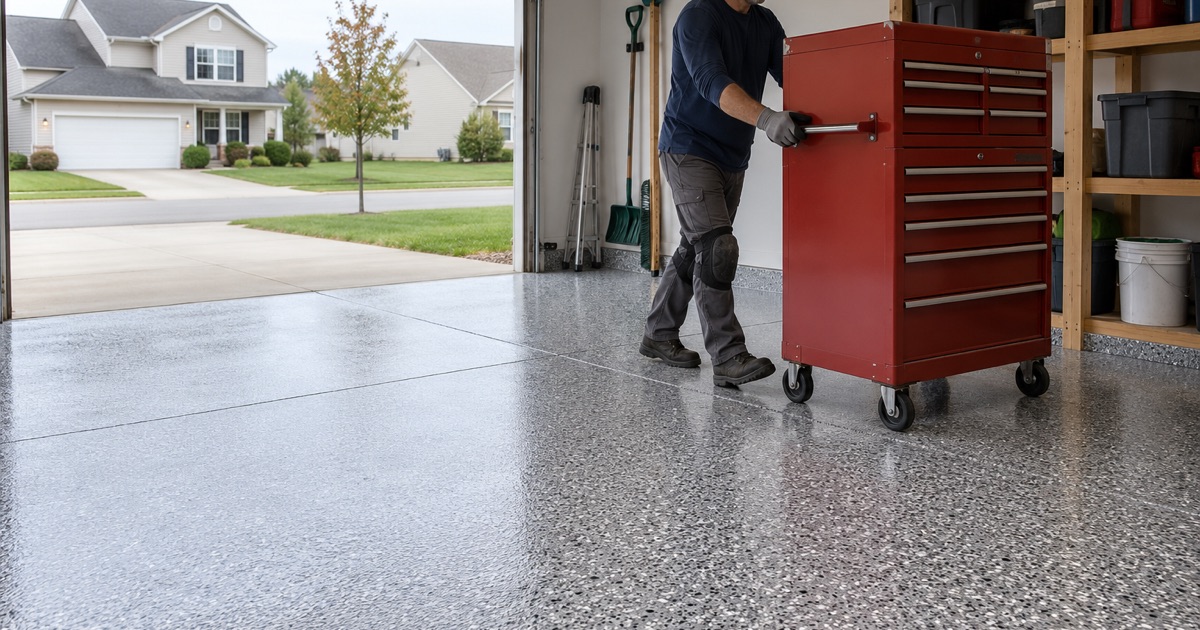
Clear polyaspartic over a full vinyl flake broadcast is one of our most common garage builds. The flake supplies color and texture, and the clear topcoat seals it and carries the wear.
Hot Tire Pickup Resistance
A tire that has been running on summer pavement is hot enough to soften weak coatings. When the car parks and cools, the tire can pull the coating off the floor in the shape of the tread. Polyaspartic and polyurea topcoats, bonded over a ground slab, resist that failure far better than thin retail coatings.
Thickness matters as much as chemistry here. A topcoat rolled on too thin wears through in the tire paths within a few years, so the proposal states the film build we are applying and we measure it as we go rather than stretching material to cover more floor.
Residential Polyaspartic Floor Coating
Polyaspartic Garage Floors
In a garage, polyaspartic gives a floor that shrugs off hot tires, resists the brine and calcium chloride a winter drags in, and can be back in use quickly. We usually pair it with a 100% solids epoxy base when a slab needs extra build or has minor surface flaws, and use a full polyaspartic system when the slab is sound and the schedule is tight.
Garage slabs in Wisconsin may have no vapor retarder beneath them, because the dwelling code does not require one under an unconditioned attached garage. That is why the moisture reading is written into every garage proposal before any coating is chosen.
Basements, Laundry Rooms and Mudrooms
Polyaspartic works well in mudrooms, laundry rooms and finished basements where people want a durable, easy-to-clean floor without waiting days for it to cure. In a basement the moisture question comes first, and a slab with high readings may need a moisture-mitigation primer under the polyaspartic.
Floor drains, sump pits and the joint at the base of the walls are detailed so the coating stops cleanly and water still runs where it should. A coating is not radon mitigation, and we do not sell a basement polyaspartic floor as one; radon reduction is its own system.
Patios, Porches and Pool Decks
Because it resists ultraviolet light, polyaspartic is suited to some covered porches and outdoor concrete. Outdoor slabs see freeze-thaw cycles and water from both sides, so we look closely at drainage, cracks and slab condition before recommending a coating outside.
A crack in an outdoor slab is often still moving with the seasons, and a coating is a film that follows the concrete beneath it. If a porch or patio is heaving or broken, we say it needs repair or replacement first rather than coating over it and hoping.
Commercial Polyaspartic Floor Coating
Showrooms, Dealerships and Service Bays
Automotive showrooms and service bays benefit from a topcoat that stays clear, handles hot tires and cleans easily. Polyaspartic lets a business return a bay to service quickly. We schedule the work around opening hours, including overnight and weekend windows, so the doors stay open while the floor is done.
Retail, Office and Light Industrial Floors
In retail and office spaces, a polyaspartic floor can be installed and walked on fast enough to fit between closing and opening. In light industrial spaces it is often the topcoat over a thicker epoxy base, where the base handles impact and the top handles wear and chemicals.
Saw-cut joints in commercial slabs are filled with a semirigid filler before coating, so carts and pallet jacks crossing them do not break the edges. Painted lines, safety zones and logos can be built into the system and sealed under the clear topcoat so they do not wear away.
Where Polyaspartic Is Not the Answer
Commercial kitchens and food plants with hot washdown often need urethane cement rather than a thin coating. Heavy industrial floors may need a thicker build than a polyaspartic system provides. We match the system to the room, not the other way around.
Installing Polyaspartic in Wisconsin and Illinois
Slab Temperature and the Dew Point
Polyaspartic tolerates cooler slabs than most epoxies, but the surface still needs to stay safely above the dew point, or moisture condenses on it and the bond suffers. We read slab temperature and the dew point spread at the surface before each coat, and when conditions are wrong we reschedule rather than gamble.
VOC Rules on Each Side of the State Line
Illinois limits the VOC content of architectural coatings an installer may apply, under 35 Ill. Adm. Code Part 223. In Wisconsin, the federal architectural coatings rule binds the manufacturer instead. We pick polyaspartic products that are compliant for the side of the line the job sits on, so a Gurnee or Zion floor gets an Illinois-compliant coating.
Grinding, Not Etching, Before Every Coat
A polyaspartic coating grips only what it can reach. We open every slab with a diamond grinder or shot blaster to a measured surface profile and vacuum the dust as we go. Acid etching leaves residue and an uneven profile, and on a fast-curing coating those flaws show up as peeling within the first year.
The dust and slurry from that preparation are collected on site and bagged for disposal, never rinsed toward a storm drain or the lake. It is a small detail, but on a busy street or near the shoreline it is the one a neighbor notices.
- 20+ Years on Concrete
- Moisture Tested First
- Written System Proposals