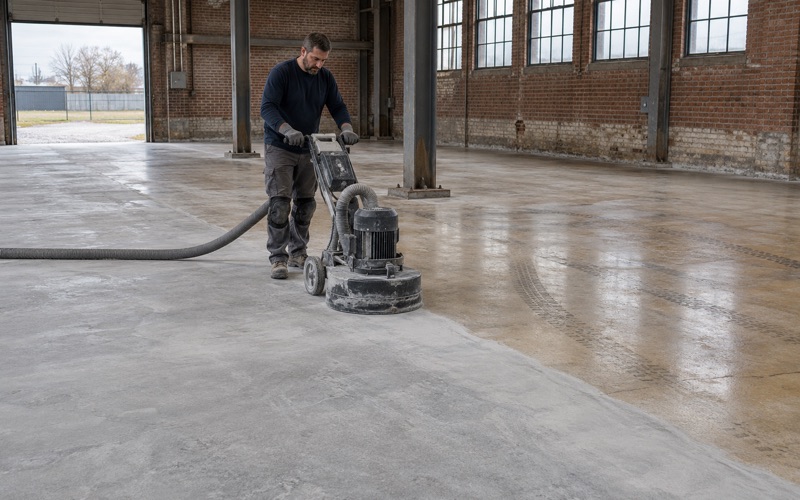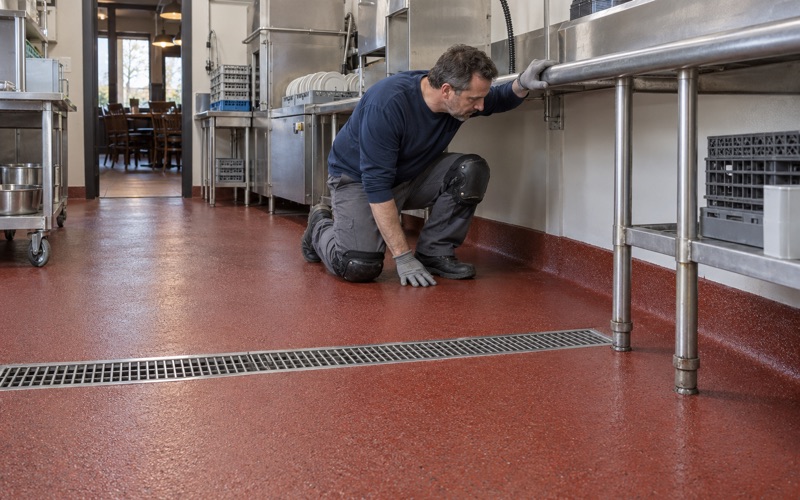
Kenosha Epoxy Flooring has spent more than 20 years on epoxy flooring in Park City and the rest of the region, and most of what decides whether a floor lasts happens before any resin is opened. A coating only holds onto concrete that has been cut open to a clean, rough profile. That cutting is the loudest, dustiest and most underestimated part of the job.
On every slab we use a diamond grinder or a shot blaster, and we never acid etch. The grind takes off the weak top skin, old sealers and contamination, and it leaves the texture a primer needs to grip. It also turns a thin layer of the floor into fine dust, and that dust is the subject of most of this page.
Below we cover the choice many homeowners weigh first: rent the grinder and do the prep yourself, or hire a crew for it. We also walk through what grinding puts in the air, the federal controls written for this exact machine, and what the rest of a garage coating job looks like once the slab is open.
Rent a Grinder on Old Skokie Road, or Hire the Prep
What the rental catalog offers
Park City has an equipment-rental branch inside its own limits: Sunbelt Rentals General Equipment & Tools Branch #1636, at 100 Old Skokie Road in Warren Township. The company’s catalog lists concrete floor grinders, industrial concrete grinders, dust collectors and vacuums, portable shot blasters and hand-held grinder-vacs. That catalog is company-wide, so call the branch to learn what it has on hand on a given day.
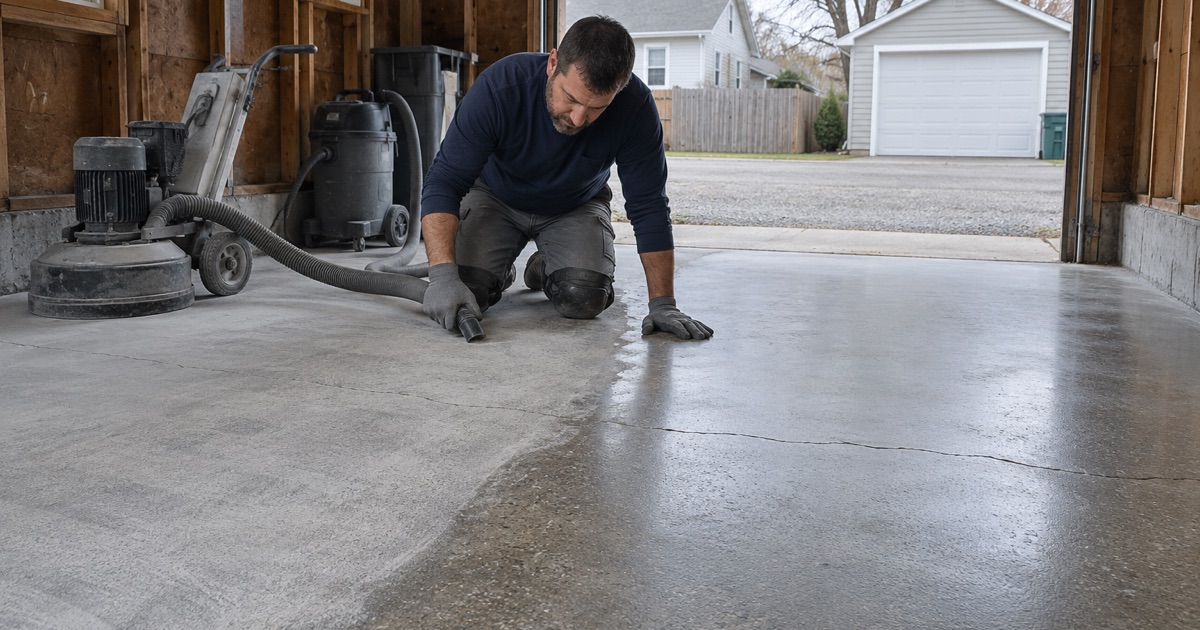
The walk-behind floor grinder is the tool most do-it-yourself garage coatings start with. It carries rotating heads fitted with diamond segments, and it is heavy enough that loading and unloading it is a two-person job. A dust collector hoses onto the grinder’s shroud and pulls the cut material away as it comes off the slab.
What the grinder is supposed to leave behind
The goal of the grind is a surface profile, usually described on the ICRI CSP 1-10 scale, matched to the system going over it. A thin roll-on coat wants a lighter profile than a 100% solids epoxy base with a vinyl flake or quartz aggregate broadcast. Getting the profile even across the whole floor, edges included, is what takes skill and time.
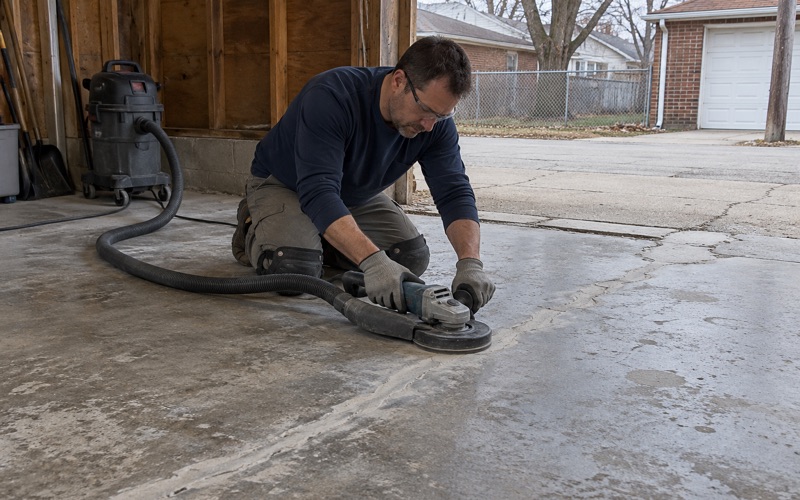
Edges, corners and the strip along the garage door are where rented setups most often fall short. The walk-behind machine cannot reach them, so they need a hand-held grinder with its own shroud and vacuum. Skipped edges are a common place for a new coating to lift first.
Doing the grind yourself versus hiring a crew
Doing it yourself saves labor, and plenty of careful homeowners grind a clean slab well. The trade-off is a day or more of loud, dusty work, plus learning the machine, choosing diamond tooling and judging the profile on a floor you only get one try at. Mistakes in prep surface later as peeling, not on the day you grind.
When we do the prep, it comes with the rest of the scope. We read the cracks, joints and old coating before quoting, and we tell a homeowner plainly when a slab needs repair or replacement before it can be coated. Some people rent the grinder after that conversation anyway, and that is a fair choice once they know what they are cutting into.
Looking for epoxy-flooring closer to Gages Lake? See Epoxy-Flooring Services in Gages Lake.
Silica and OSHA’s Floor-Grinder Line
What grinding a garage slab puts in the air
Concrete contains quartz sand, and cutting or grinding it releases respirable crystalline silica. Those particles are small enough to travel deep into the lungs, and they hang in still air long after the visible dust settles. Long-term exposure is linked to silicosis and other lung disease, which is why the construction trades treat grinding dust as a hazard and not as a nuisance.
An attached garage is close to a closed box once the overhead door comes down for the grind. Dust that is not captured at the grinder spreads to shelves, stored items and the gaps around the door into the house. We have no measurement of silica in any Park City garage, but the mechanism is the same in every slab that gets ground.
OSHA 29 CFR 1926.1153 Table 1, item (xiii)
OSHA’s construction silica rule, 29 CFR 1926.1153, includes a Table 1 that lists common tools and the controls that go with each. Walk-behind milling machines and floor grinders have their own line, item (xiii). It gives two options: a machine with an integrated water delivery system that continuously feeds water to the cutting surface, or a dust collection system recommended by the manufacturer.
That dust collector must deliver at least the airflow the manufacturer recommends and carry a filter of 99 percent or greater efficiency with a filter-cleaning mechanism. Indoors or in an enclosed area, the line adds a HEPA-filtered vacuum to remove loose dust between passes. When those controls are fully in place, the table requires no respirator for that task.
Who the rule binds
The silica rule applies to employers and their workers. A homeowner grinding a personal garage floor is not covered by it, and nothing in it makes that work illegal. It is still the most specific published guide to controlling floor-grinder dust, and it was written for the same machine a homeowner may rent.
We run our own prep to that Table 1 line because our crews are covered by it. For a homeowner doing the grind alone, it works as a practical checklist: a matched collector with a high-efficiency filter, a HEPA vacuum, and a cleanup method that does not put the dust back in the air.
HEPA Between Passes, and Why the Broom Stays Out
Vacuuming between passes
A floor grind usually takes several passes, often with coarser tooling followed by finer. Loose dust left on the slab between passes is picked up and thrown again by the next pass. The Table 1 line calls for a HEPA-filtered vacuum to remove that loose dust between passes indoors, and we follow it.
The vacuum’s filter matters as much as its suction. A standard shop vacuum without a HEPA filter can blow the finest particles straight through the exhaust and back into the room. A HEPA-filtered unit, ideally the one matched to the grinder, keeps that fraction in the bag.
No dry sweeping, no compressed air
The same rule, in paragraph (f)(1), bars dry sweeping or dry brushing where it could add to exposure, unless wet sweeping, HEPA vacuuming or similar methods are not feasible. A push broom on a freshly ground slab lifts the finest dust back into the breathing zone. That is why there is no broom in our prep kit.
Paragraph (f)(2) covers compressed air, which is not to be used to clean surfaces unless a ventilation system captures the dust cloud and no alternative is feasible. A leaf blower used to clear a garage floor works the same way. It moves silica into the air, onto the driveway and back through the garage door.
Where the dust and slurry go
Grinding dust and slurry are collected on site and never washed toward a street drain. A water-fed grind produces wet slurry instead of airborne dust, and that slurry needs to be vacuumed or squeegeed into a container and disposed of properly. Hosing it down the driveway sends cement fines into the storm system.
A dry grind with a collector leaves a full bag or drum of fine dust. We seal it before it leaves the garage so emptying it does not undo the control work. A homeowner using rented equipment should plan the same step before starting, not after the bag is full.
After the Grind: Attached Garages and the Rest of the Job
The door into the house
In an attached garage, the door into the house is the main path for dust to reach living space. We close it, seal the gaps and keep traffic through it to a minimum while grinding is under way. Furnaces or water heaters in the garage need to be considered as well, since they draw garage air.
Shelving, tools and stored items are best moved out or covered before the grind starts. Dust settles on every horizontal surface, and anything left in the room will need its own careful cleanup. Plastic sheeting can protect what cannot be moved.
Testing and reading the open slab
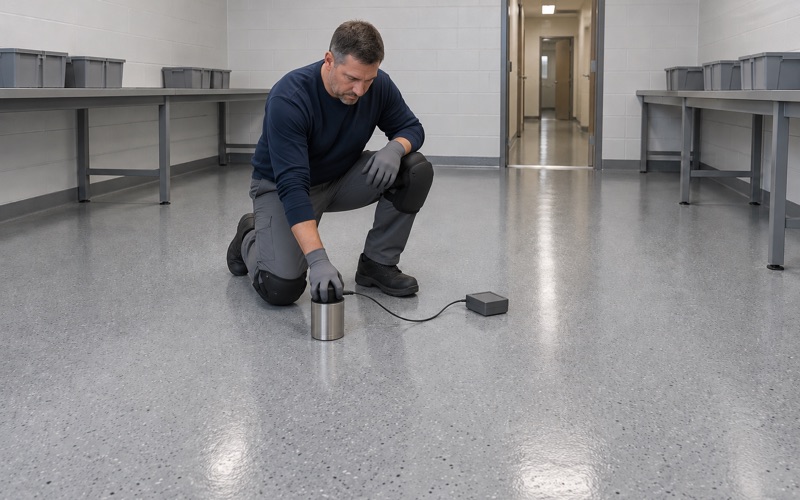
Once the slab is ground, its condition is easy to read. Moisture testing is a line item in our scope on every garage slab, using ASTM F1869 calcium chloride tests or ASTM F2170 in-situ relative humidity probes, rather than something offered after a floor has blistered. Warranty exclusions are read out before the job is sold, with moisture named first.
Cracks and joints show up clearly on a ground floor. We repair what can be repaired and say plainly when movement will continue, because a coating is a film that follows the slab under it rather than something that stops it from moving. Promising otherwise sets a homeowner up for disappointment.
Products, curing and the written proposal
Park City sits on the Illinois side of the state line, where 35 Ill. Adm. Code Part 223 limits the VOC content of the architectural coatings an installer may apply. We choose products with that rule in mind, and our proposal names the product, the system build and the finished thickness, so what was quoted can be checked against what was installed. Garage systems often finish with polyaspartic or polyurea topcoats built for road salt and hot tire pickup.
Curing is scheduled against slab temperature and dew point, not the calendar, and we say plainly when an unheated garage has to wait for spring. We could not find Park City’s contractor registration or permit rules for floor coating online, so we check with the City of Park City before a job is scheduled. Every step of that schedule starts with a properly ground, properly cleaned slab.
- 20+ Years on Concrete
- Moisture Tested First
- Written System Proposals