Kenosha Epoxy Flooring has spent more than 20 years installing epoxy flooring in Mount Pleasant garages, basements, shops and plant floors, and the first thing we check on any slab here is what has already been put on it. A coating bonds to open concrete, not to whatever sits on top of the concrete. When a floor has been waxed, polished or sealed with a finish, that layer has to come off before resin goes down, or the new floor lets go.
That is why our visit starts with a test rather than a color chart. We pour water, read how the surface takes it, and look over the cracks, joints and any old coating before we write a scope. If a slab needs repair or replacement before it can carry a coating, we say so at that visit rather than after a deposit.
Our proposals name the product, the system build and the finished thickness, so a homeowner or plant manager can hold what was quoted against what went down. Moisture testing sits in that scope as its own line, and the warranty exclusions are read aloud before anything is signed, with moisture at the top of the list.
A Floor-Wax Town’s Floors Need the Wax Off First
Where the Floor-Care Lineage Started
Mount Pleasant is a village in Racine County, about 30 miles south of Milwaukee and 60 miles north of Chicago, and it has an unusual connection to floors. In 1886 Samuel Curtis Johnson bought the parquet flooring business of Racine Hardware Manufacturing Company in Racine, and every Johnson parquet floor came with a can of Johnson’s Prepared Paste Wax.
That business became SC Johnson, and its Waxdale Manufacturing Facility on 16th Street lies inside the village. The company describes Waxdale as its largest global manufacturing facility, operating in Mount Pleasant for more than 60 years. Diversey’s floor-care line runs through the same story, with the JohnsonDiversey Distribution Center at 901 Renaissance Boulevard.
What a Finish Does to a New Coating
None of that history tells us what is on a particular slab, and we never assume a floor has been waxed. What it does explain is why we ask every time. A shop, office or basement floor that has been waxed, polished or given an acrylic floor finish over the years carries a film that resin cannot grip.
Epoxy and polyaspartic coatings need to wet into an open concrete surface and lock into its profile. Laid over wax or finish, they bond to the film instead, and the film releases from the concrete under foot traffic, hot tires or a dropped tool. The result is peeling in sheets, usually in the traffic lanes first, and no topcoat can fix a failed bond underneath.
Homes Across the Village
Most of the village’s housing is single-family, with 7,700 detached homes and 876 attached single-family units in the Census count. Many were built between the 1960s and the 2000s, and a garage or basement slab from any of those decades may have had a sealer, paint or finish put down by a past owner.
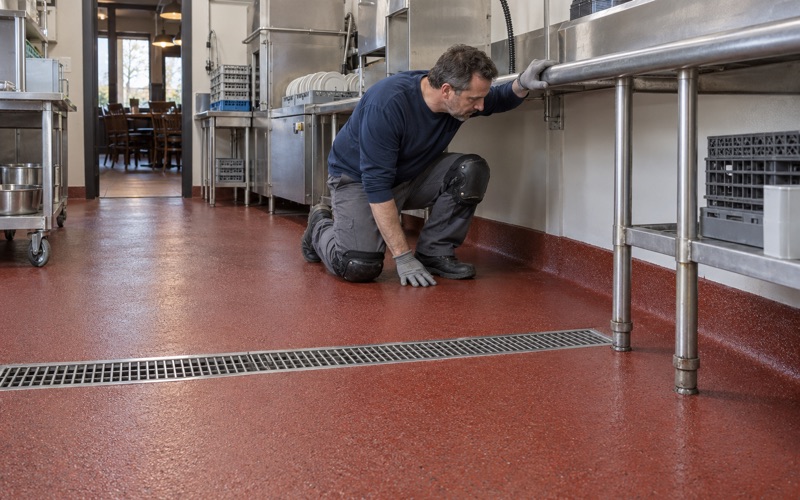
Garage floors often carry an old acrylic sealer, and finished basements and former workshop spaces may hold years of polish residue or floor compound. Each of these reads the same way to a coating: a slick layer between the resin and the concrete. How much of it is there decides how much stripping and grinding the job needs, and that goes into the price we quote.
Looking for epoxy-flooring closer to Zion? See Epoxy-Flooring in Zion.
The Water Test That Tells Us What Is on the Slab
How the Test Works
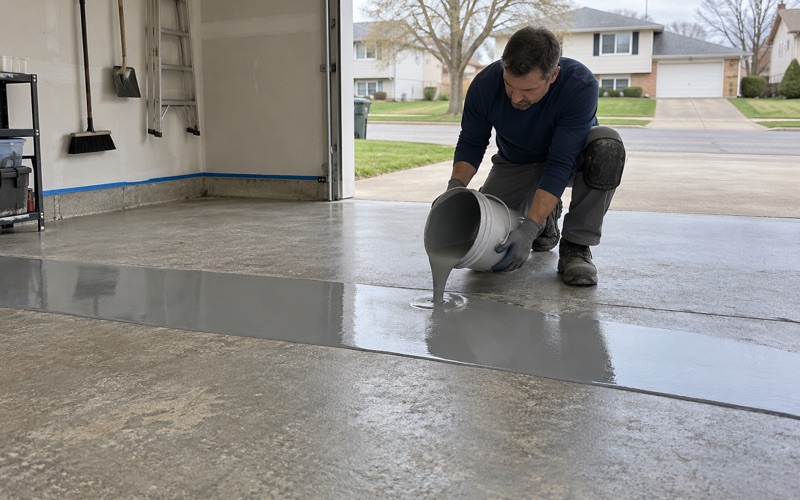
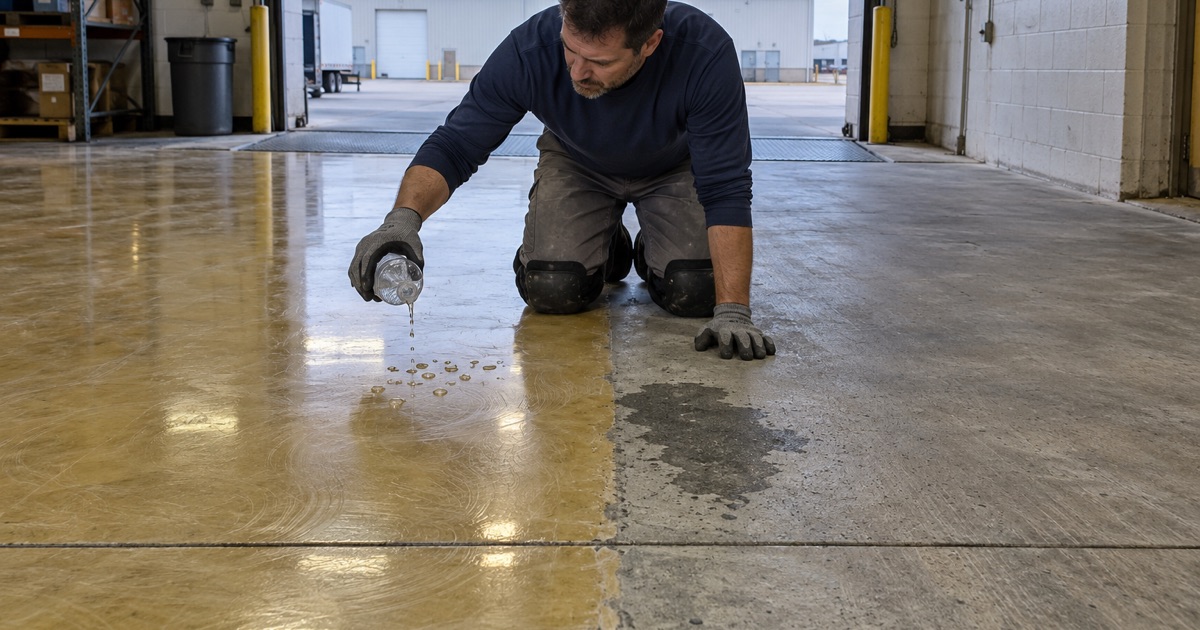
Manufacturer data sheets give a simple field check. Pour water on the concrete and watch it. If the water soaks in and darkens the slab, the surface is porous and open. If it beads and sits on top, the surface is not porous, and the Rust-Oleum EasyClear data sheet says sanding or mechanical abrading may be required before coating.
We run that test in several places across a floor, not just one spot near the door. A slab can be open in the middle and sealed along the walls where an old finish never wore off, and a single test would miss it. We mark the beading areas so the crew knows exactly where the film is still holding.
What the Data Sheets Require
The products we install agree on the point. The Rust-Oleum 6000 System data sheet calls for removing grease, oil, floor compound or wax before coating, and the APF Prime Seal sheet requires a surface free of wax, loose paint or curing compounds. A coating installed against those instructions is outside what the manufacturer stands behind.
That matters to the owner as much as to us. An unprepared surface is one of the conditions a manufacturer can cite when a claim comes in, which is why it belongs in the conversation about exclusions before the job is sold. Following the data sheet is how a warranty stays worth the paper it is printed on.
Testing Moisture at the Same Visit
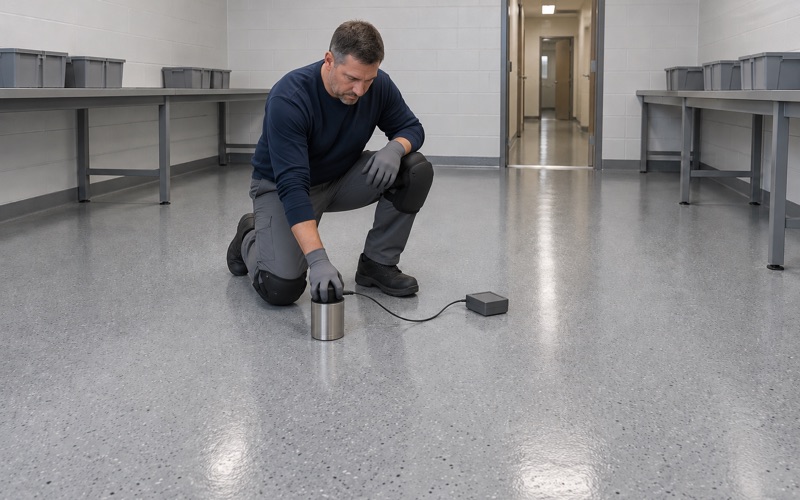
Beading tells us about the surface. It says nothing about moisture rising through the slab, which is a separate failure with its own test. We check for it with an ASTM F1869 calcium chloride test or ASTM F2170 in-situ relative humidity probes, depending on the floor, on a basement slab and a garage slab alike.
Under SPS 322.38(3), Wisconsin requires a 6-mil vapor retarder under new dwelling slabs but not under an unconditioned attached garage slab. A garage floor that looks dry can still be pushing moisture up from the ground, so we test before we coat rather than learn the answer from a blister.
Why We Grind Instead of Acid-Etching a Finished Floor
Acid Cannot Reach Under Wax
Acid etching is sold as easy prep, but it does not remove wax. The acid has to react with the concrete to open it, and wax or a floor finish keeps it from reaching the concrete at all. The floor may look rinsed and clean while the film is still there, waiting to release whatever goes on top of it.
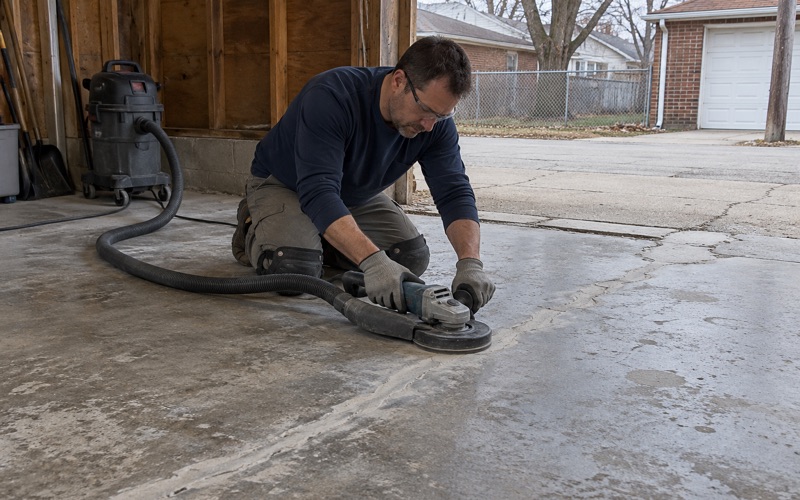
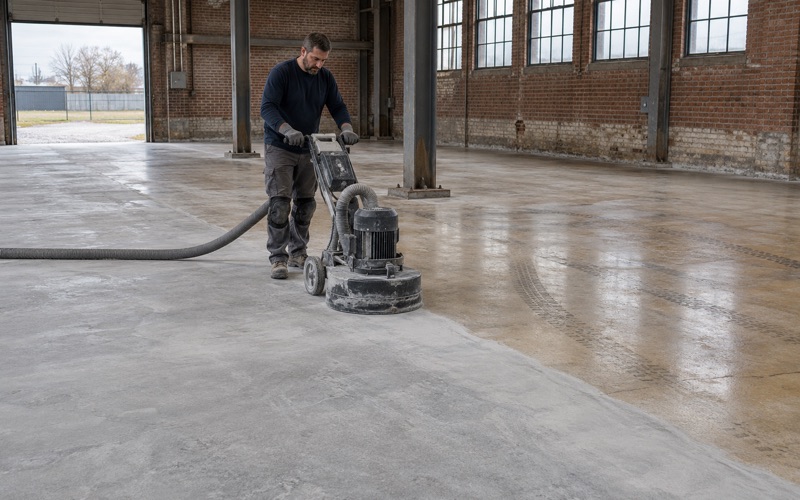
We do not acid etch any floor, finished or bare. Every slab is opened mechanically with a diamond grinder or a shot blaster, which cuts through the film and into sound concrete in the same pass. That leaves a profile the primer can bite into, measured against the ICRI CSP scale the system calls for.
Stripping Plus Grinding on Heavy Buildup
A floor with thick layers of wax or finish can load a grinder’s diamonds so they smear rather than cut. On those floors we strip first to take off the bulk of the buildup, then grind to the profile. The water test is repeated afterward, and water should soak in everywhere before any resin is mixed.
That second test is the proof. If a patch still beads, it gets ground again until it takes water like the rest of the slab. It is a slower start than a bucket of acid, and it is the step that decides whether the coating holds for years or peels in its first winter.
Dust, Slurry and Curing
Grinding makes dust and, on wet work, slurry. We collect both on site and never wash either toward a street drain or the lake. Once the slab is open and tested, curing is scheduled against slab temperature and dew point rather than the calendar, and an unheated garage may have to wait for spring.
We also explain what a coating cannot do. It is a film that follows the slab under it, so it will not stop a crack that is still moving. Where the cracks and joints show active movement, we say so before the job and talk through repair rather than promise the coating will hold the slab together.
Garage Slabs, Village Permits and Plant Floors
The Village Permit Drawing
New garages and sheds in Mount Pleasant go through Village of Mount Pleasant Building Inspection, which handles permits in-house. The structural drawing has to show a cross section of the garage slab or foundation, wall and roof construction, and attached garages show a footing depth of at least 48 inches below grade.
The village’s Accessory Structure Wall Section may only be used as the structural drawing for a garage or shed on a concrete slab on grade, and Village Engineering reviews grading and drainage before a garage or shed permit issues. For a newer slab, that drawing is a useful record of how the floor we are about to coat was built.
Permits and Contracts for Coating Work
Wisconsin issues no license for floor coating work, so before a job is scheduled we confirm with the village building inspector whether it needs a permit. The answer depends on the job, and we ask rather than assume.
Every home job gets a written contract before any deposit, as Wisconsin’s ATCP 110 rule requires when payment is due before completion. The products and any warranty are written into that contract, so the agreement says the same thing the proposal did.
Plant and Warehouse Floors Along Renaissance Boulevard
The industrial side of the village keeps growing. Foxconn makes AI servers in Mount Pleasant and plans 700 more jobs by mid-2027, and Kedali America plans a $72 million EV battery-can plant in a 229,755-square-foot building on Meridian Drive. Warehouse space along Renaissance Boulevard and the I-94 corridor fills out the mix.
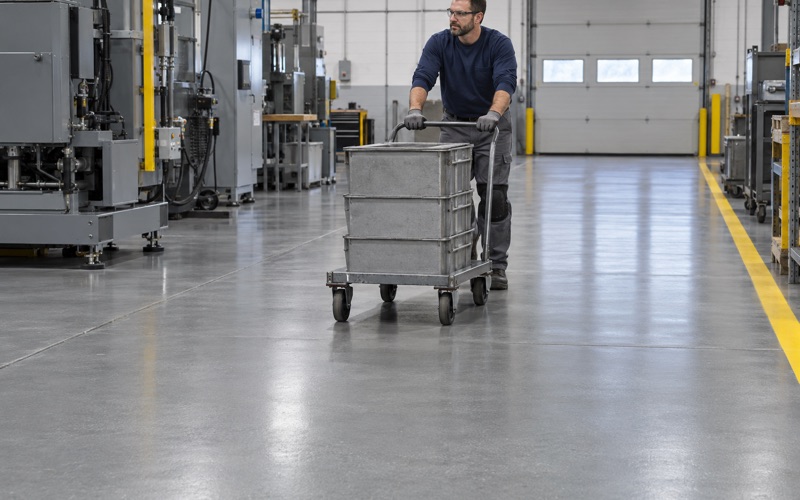
A plant or warehouse floor that has been on a floor-care program can carry the same finish problem as a garage, across far more square footage. We water-test the whole floor, grind it to open concrete, and schedule the work around the hours the building has to keep running, including overnight and weekend windows.
- 20+ Years on Concrete
- Moisture Tested First
- Written System Proposals