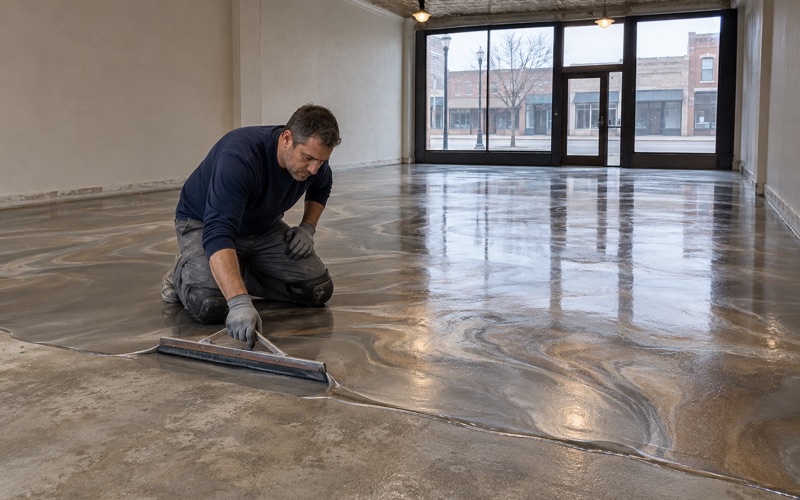
Kenosha Epoxy Flooring brings more than 20 years to epoxy flooring in Lindenhurst, and on a service-bay floor the first question we ask is not about color or flake. It is about the hours the shop keeps. A coating that needs longer to harden than the shop stays closed is the wrong system for that floor, however good it looks on a sample board.
So we start with the gap between closing time and opening time, then work backward to the product. The data sheet’s vehicle-traffic cure, read at the temperature the slab will actually be, tells us whether a fast-cure polyaspartic or a slower 100% solids epoxy fits. Every proposal names that product, the system build and the finished thickness, so what we quoted can be checked against what went down.
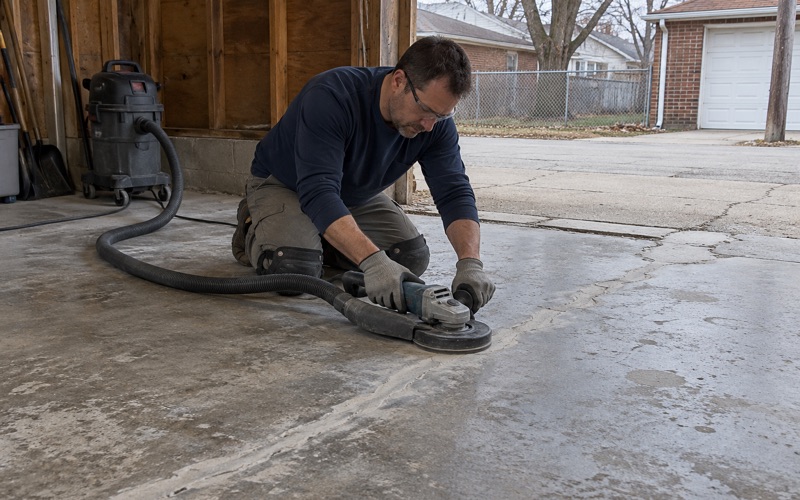
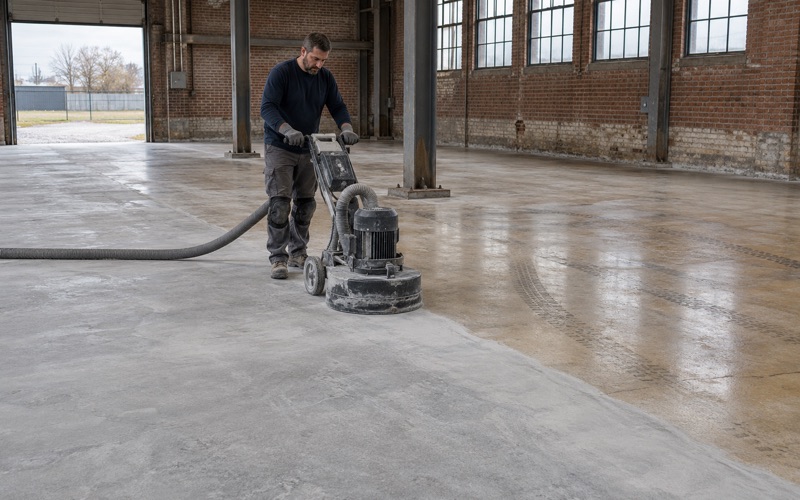
Nothing about the schedule changes the prep. Every slab is opened with a diamond grinder or shot blaster, never acid etched, and moisture testing is a line item rather than an afterthought. What the schedule changes is the order of work, which bays close first, and how many nights or weekends the job takes.
Six Days of Service Hours on Grand Avenue
Journey Nissan’s service department at 3175 Grand Avenue, an address inside the village in Lake Villa Township, shows how tight a dealership calendar gets. Its posted service hours run Monday through Friday from 7:00 a.m. to 6:00 p.m. and Saturday from 7:00 a.m. to 3:00 p.m., with Sunday closed. We use it here as an example of the schedule, not as a client, and we have not seen its floors.
Thirteen hours on a weeknight
From a 6:00 p.m. close to a 7:00 a.m. open is about 13 hours. That window has to hold far more than coating: cars moved out, lifts cleared, grinding, vacuuming, priming, any broadcast, the topcoat, and enough cure for the first repair order of the morning to roll in. In practice the coating itself gets only part of those hours.
Grinding and dust collection alone take a real share of a bay’s night, and the slurry is collected on site rather than rinsed toward a floor drain or street drain. What is left over for cure decides whether one overnight is enough for a given product, or whether the bay stays closed into a second night.
Forty hours from Saturday afternoon to Monday morning
Saturday 3:00 p.m. to Monday 7:00 a.m. is about 40 hours, the longest stretch those posted hours allow. That is roughly three times the weeknight window, and it changes what can go down. A multi-coat build with a slower epoxy body coat becomes possible on a weekend where it would not fit a Tuesday night.
The weekend also buys margin. If a primer coat shows amine blush, or a slab reads cooler than expected, there is time to deal with it properly instead of rushing the topcoat. We would rather plan the heaviest bays for weekends and keep weeknights for smaller, simpler areas.
A drive that keeps working while the floor is down
The dealership also offers Nissan Mobile Service, sending techs out for oil changes, tire rotations and batteries at customers’ homes or offices. Whether that helps carry a floor project is the service manager’s call, not ours. It does not replace bays that need lifts, so the phasing plan still has to leave enough working bays open every day.
Looking for epoxy-flooring closer to Caledonia? See Epoxy-Flooring Services in Caledonia.
Vehicle-Traffic Cure Is the Number That Decides It
Every coating data sheet lists more than one cure time, and they mean different things. Tack-free, recoat, light foot traffic, vehicle traffic and full chemical resistance are separate lines. On a service floor the line that governs the schedule is vehicle-traffic cure, read at the slab temperature on the night of the work.
Tack-free is not ready
A floor can feel dry under a fingertip hours before it can take a tire. Turning a wheel under load on a coating that has not reached its vehicle-traffic cure invites hot tire pickup, a scuffed topcoat and marks that will not buff out. We plan the reopening around the vehicle-traffic line, not around how the floor feels at 5:00 a.m.
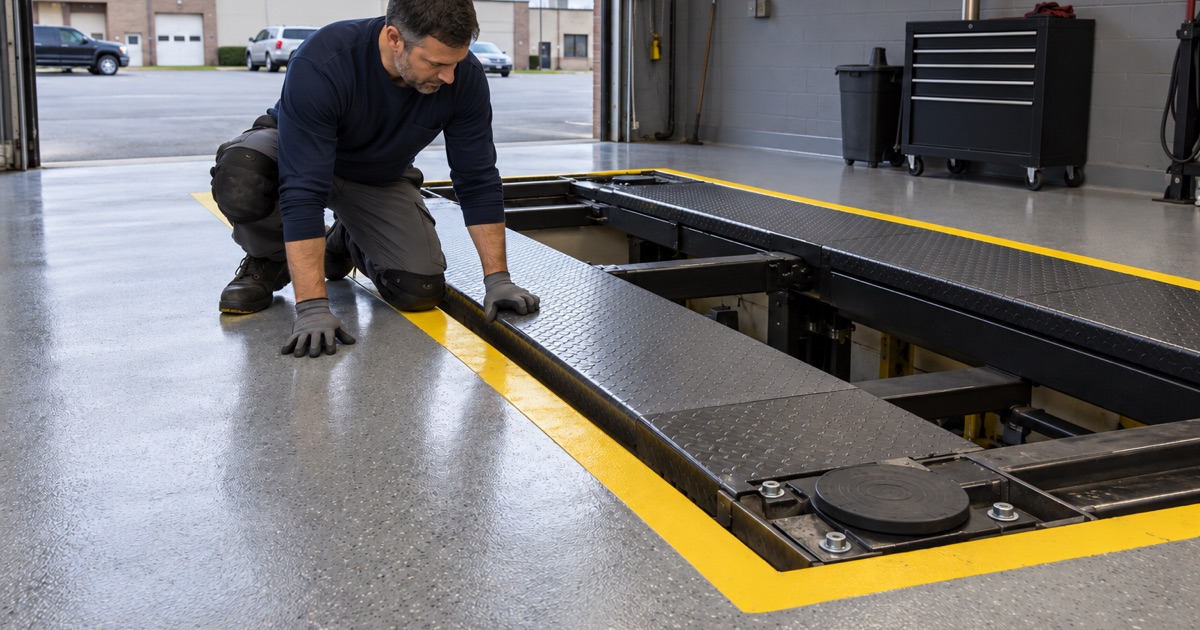
Lift work adds point loads a parking stall never sees. Lift pads, jack stands and rolling tool carts all press into a fresh film. When a bay goes straight back to lift work, we schedule against the more conservative line on the data sheet rather than the earliest one.
Slab temperature moves every number
Cure times on a data sheet are stated at a reference temperature, and a cooler slab stretches them. We measure the slab and the dew point spread at its surface rather than trusting the thermostat, because a bay door that opened all day can leave concrete colder than the room. That reading decides whether a product’s published window still fits inside 13 or 40 hours.
No number on a data sheet is a promise, and we do not quote one as a guarantee. We give the service department the cure line for the chosen product at the measured temperature. If the reading puts a bay at risk of missing its reopening, we say so before the bay is closed.
Moisture comes before the clock
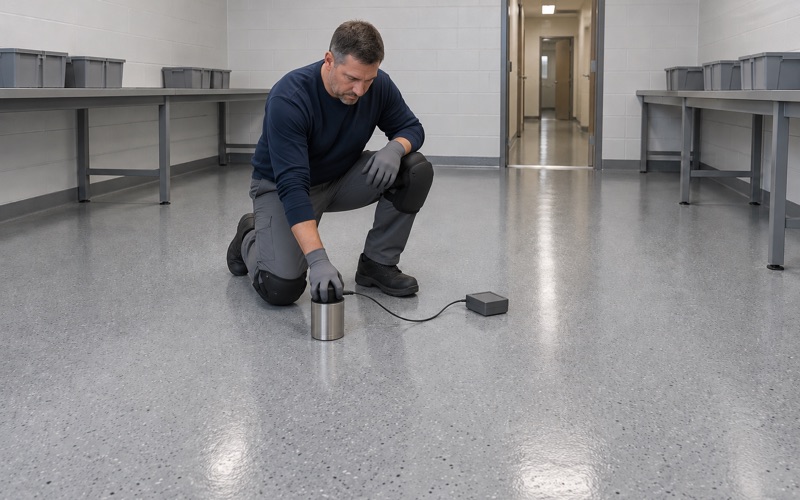
A fast schedule does not excuse skipping a moisture test. Well before the install night we run ASTM F2170 in-situ relative humidity probes or ASTM F1869 calcium chloride testing as part of the scope. If the readings call for a moisture-mitigation primer, that coat and its cure enter the schedule like any other.
Warranty exclusions are read out before the job is sold, with moisture named first. A service manager should know what the warranty does not cover before signing, not after a bay starts to blister. That conversation takes ten minutes and saves the argument later.
Phasing Bays So the Service Drive Stays Open
A service department rarely closes the whole floor at once. We map the bays, the drive lane and the write-up area, then agree with the service manager on which sections close on which nights. Each phase gets its own prep, coating and cure, and its own reopening time.
Setting the order of work
Bays that carry the heaviest lift work usually go into weekend windows, where the extra hours buy margin for cure. Lighter areas, such as aisles or a write-up lane, can often fit a weeknight if the product’s vehicle-traffic line allows it. The order is set by cure time and by which bays the shop can spare, not by where the crew happens to start.
We read the cracks, joints and any old coating before quoting. Saw cuts in a service floor see constant wheel crossings, so joints are filled with a semirigid filler before coating to keep the edges from breaking under tires. Where a slab section needs repair before it can be coated, we say so up front and the repair joins the phasing plan.
Edges between phases
Every phase leaves a seam where new coating meets bare or old floor. We place those seams at joints or bay lines where we can, grind a clean termination, and plan the overlap so the next night’s coat ties in without a ridge. A seam dropped in the middle of a wheel path is a weak point a service floor finds quickly.
Dust control matters more when the next bay over is still writing repair orders. Our grinders run with vacuum collection, and the work area is closed off before grinding starts. The morning shift should walk into a working shop, not a film of concrete dust on the cars waiting in the drive.
Other service floors in the village
The village business directory lists Great American Tire & Auto Repair at 1890 E Grand Ave and NG Automotive at 465 S. Route 45 alongside the dealership. We name them only as the kind of floor this applies to, since independent shops keep their own hours. The method stays the same: find the closed window, read the vehicle-traffic cure, then phase the bays.
Choosing the System to Fit the Gap
Once the window is known, the system follows. The choice is usually between a fast-cure polyaspartic build and a slower 100% solids epoxy, sometimes combined in one floor. The data sheet, read at the measured slab temperature, settles which one fits each phase.
Fast-cure polyaspartic for weeknights
Polyaspartic and polyurea topcoats are built to reach traffic readiness faster than most epoxies, which is why they are the usual candidate for a 13-hour night. The trade-off is a shorter working time once mixed, so crew size and bay size have to match. A big bay rushed under a short pot life is how lap marks happen.
Fast cure is still not instant. We check the vehicle-traffic line for the specific product at the slab’s temperature, then plan the coats so the last one finishes early enough to reach that line before the 7:00 a.m. open. If the numbers do not close, the bay moves to a weekend.
Slower epoxy when the weekend allows
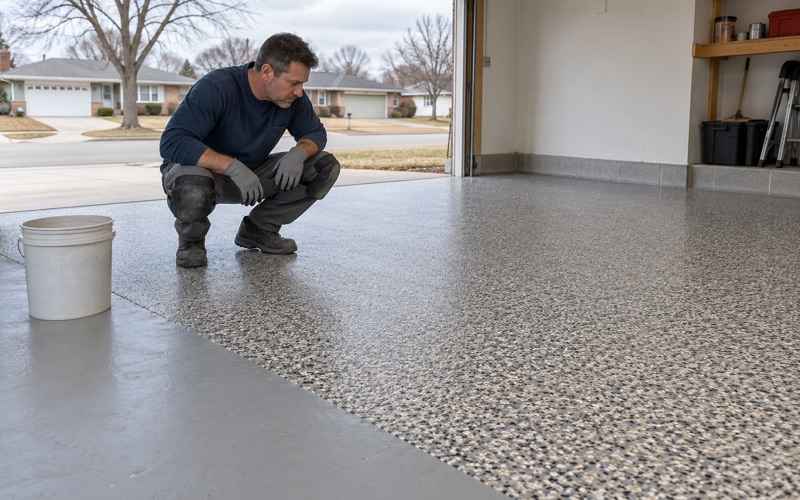
A 100% solids epoxy body coat builds thickness in fewer passes and holds a broadcast well, whether vinyl flake or quartz aggregate for texture. Its slower cure suits the long weekend window. A polyaspartic topcoat over it can shorten the last step, where the system’s data sheet supports that build.
A coating is a film that follows the slab under it, so it will not stop a moving crack beneath a lift post. We say that before the job, along with the finished thickness and which product goes down in each coat. Nobody should learn it from a crack telegraphing through a new floor.
Permits, bonds and paperwork
The village tells owners to call Village Hall to find out whether flooring work needs a permit, so we make that call for each job rather than assume an answer either way. For permitted work, Lindenhurst requires every contractor except plumbers to file a one-year $5,000 License & Permit Bond, and the village is clear that the bond is not a certificate of insurance. Illinois also limits the VOC content of the coatings an installer may apply, so every product we choose on this side of the state line is checked against that rule.
- 20+ Years on Concrete
- Moisture Tested First
- Written System Proposals