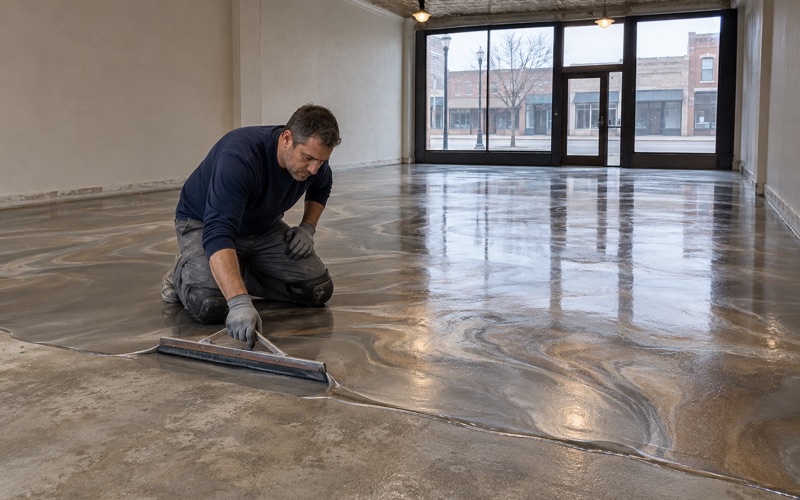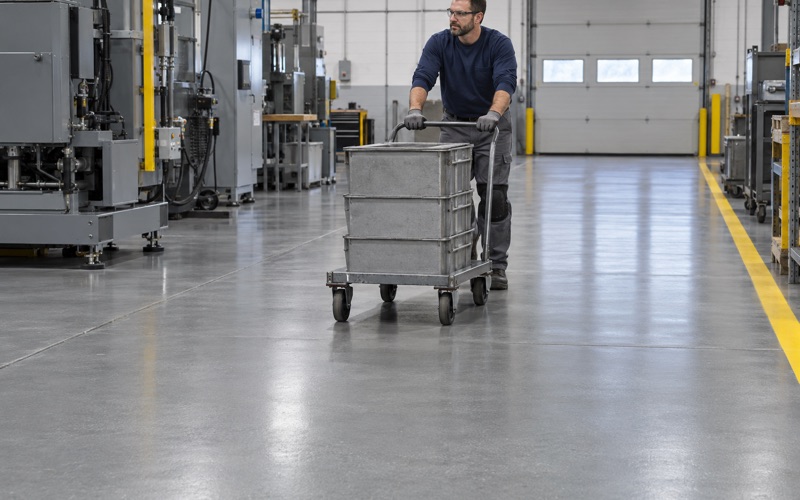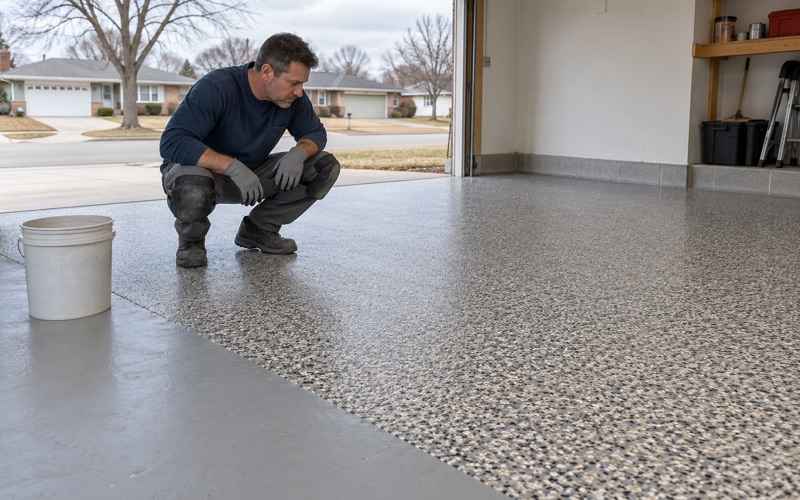
Kenosha Epoxy Flooring has spent more than 20 years on epoxy-flooring in Lake Forest and across our service area, and some of the floors we are asked about here are not floors anyone lives on. A barn aisle, a chicken coop or a kennel run takes a beating that no kitchen or family room ever sees. We size those jobs for acid, water and footing before we talk about color.
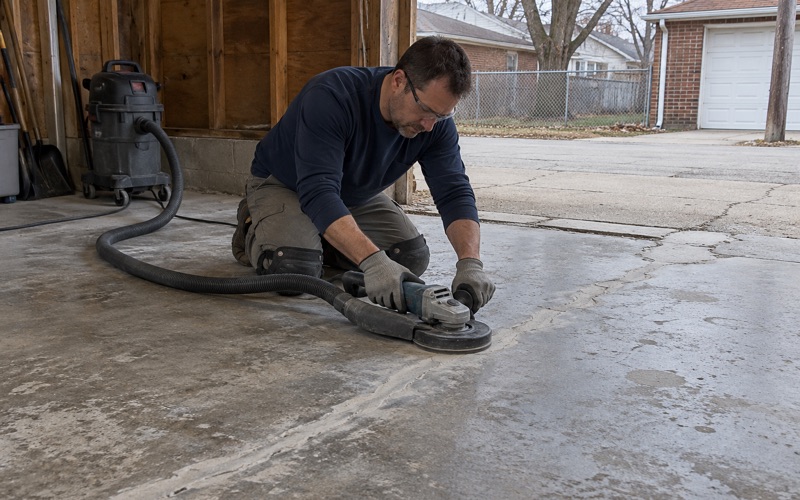
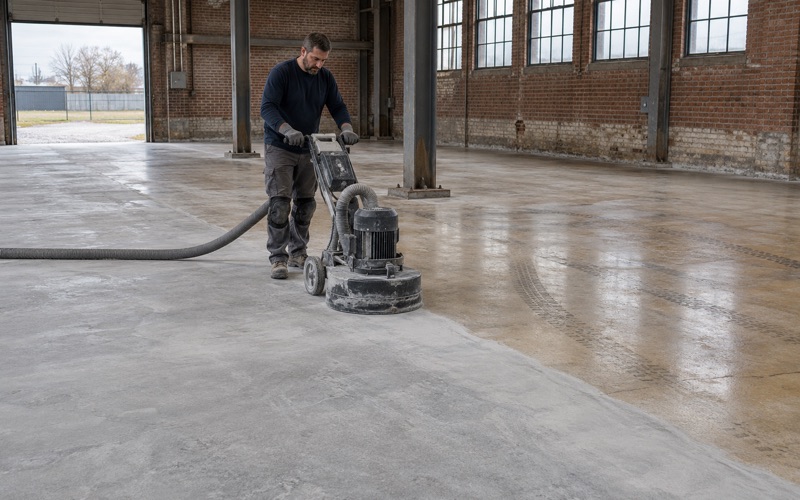
The first thing we do on any slab is open it mechanically, with a diamond grinder or a shot blaster, and we never acid etch. The profile we cut is what a 100% solids epoxy or a urethane cement grips, and an animal floor is the worst place to learn that a coating went down over a smooth, weak skin. That surface work is written into every proposal.
Our proposals name the product, the system build and the finished thickness, so an owner can check what went down against what was quoted. We read the cracks, joints and any old coating before pricing, and we say so when a slab needs repair before it can carry a coating at all. Moisture testing sits in the scope as its own line item.
Goats, Ducks and Chickens on a City-Owned Farm
The Elawa Farm Barn and Coops
The City of Lake Forest owns a working farm with animals on it. Elawa Farm, at 1401 Middlefork Drive, was built in 1917 for A. Watson and Elsa Armour, and the city bought the property in 1998. The city maintains the historic buildings, while the Elawa Farm Foundation runs the programs.
In January 2024 the city’s Zoning Board of Appeals recommended, 5-0, variances for three small farm structures there: a prefabricated steel goat barn and coops for ducks and chickens. An updated Special Use Permit allows a limited number of farm animals. The goats are a dwarf breed, and they are put in the barn at night.
What That Approval Tells a Floor Owner
We have not seen the floor inside that barn, and it may be gravel, rubber mats or a bare slab. What the minutes do show is a building where animals stand for hours every night, and where the manure is composted and hauled away rather than left in place. That routine is what any small barn floor in town has to survive.
The same questions apply to a private hobby barn or coop on a Lake Forest lot. We know of no city rule that requires a coated barn floor, and we never suggest one does. The choice is the owner’s, and our job is to lay out what each option does under daily animal use.
A Barn Floor Is Not a Garage Floor
In a garage, the threats are hot tire pickup, dropped tools and the road salt tracked in on tires. A barn floor faces a different list: acid from waste, water every day, and animals that need sure footing on a wet surface. The same slab preparation applies, but the system build above it changes.
That is why we treat an animal floor as its own system rather than a garage floor with extra grit. The base coat is chosen for chemical resistance, the texture for hooves and the topcoat for repeated scrubbing. A floor built that way still needs good habits, but it gives the owner a surface that cleans quickly instead of soaking up what lands on it.
Looking for epoxy-flooring closer to Cudahy? See Epoxy-Flooring in Cudahy.
What Manure and Urine Do to Bare Concrete
Organic Acids and Cement Paste
Liquid manure carries organic acids, among them acetic, propionic and butyric acid. Research on livestock floors has found that these acids attack hardened cement paste in a way comparable to strong acids. On a bare slab, the paste between the stones softens and washes out first, leaving a rough, pitted surface that holds even more waste.
Urine adds to the exposure, because it soaks in wherever animals stand and rest. Where manure sits without air, hydrogen sulfide from its fermentation is another known cause of rapid barn floor deterioration. A small barn cleaned every day will see far less of that than a floor over manure storage, but the chemistry points the same way.
Why a Sealed Floor Changes the Math
A continuous resin floor puts a film between that acid and the cement paste. A 100% solids epoxy base, or a urethane cement where hot water and heavy wash-down are expected, gives the waste nothing porous to soak into. The floor still has to be cleaned, but cleaning then removes the waste instead of chasing it into the slab.
A coating is only as sound as the slab beneath it, and we say that before any job is sold. It is a film that follows the concrete, so a moving crack under a stall will show through in time. Where a slab is already pitted from years of use, we grind past the damaged paste and rebuild the profile before any resin goes down.
Moisture Under an Outbuilding Slab
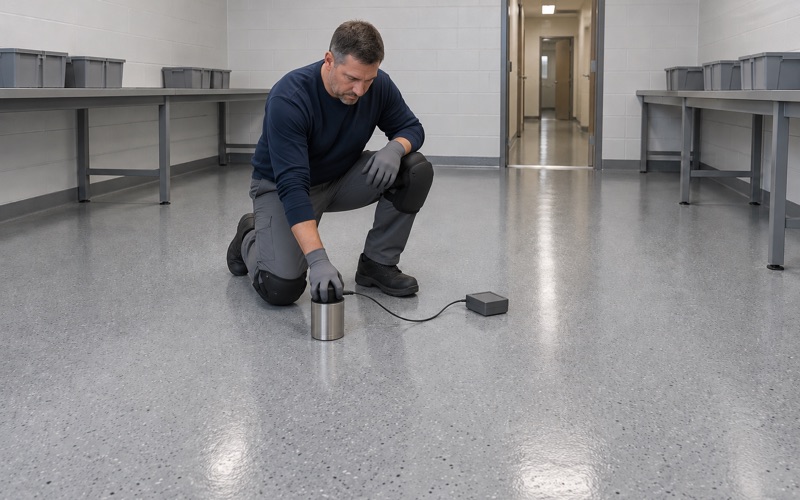
Outbuilding slabs are not always poured over a vapor retarder, and a slab on grade that looks dry can still push moisture up from below. We test before we coat, using ASTM F1869 calcium chloride kits or ASTM F2170 in-situ relative humidity probes depending on the slab. When the readings run high, a moisture-mitigation primer goes into the system, and the proposal says so.
Warranty exclusions get read out before anything is signed, and moisture is the first one we name. An owner who knows the limits up front can decide whether to mitigate, wait or choose a different floor. That conversation costs far less than a coating that blisters off a stall floor in its first season.
Washing a Barn Floor Down and Keeping Hooves Planted
Built for a Daily Wash
An animal floor gets hosed, scrubbed and often sanitized every day, so the coating has to tolerate standing water and repeated cleaning. We favor a seamless system with no grout lines or open joints where waste can lodge. Wall edges can be turned up a few inches as an integral cove, which keeps wash water off the base of the walls.
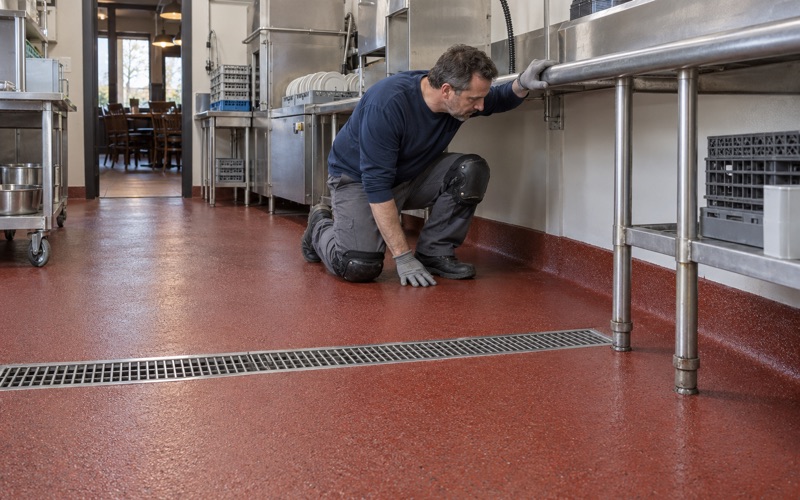
Floor drains and any sump pit need detailing before the coating goes on, not after. The resin should run cleanly into the drain body, and the slab should already fall toward it, because a coating cannot correct a floor that ponds. If the slope is wrong, we say so and price the correction separately.
Cleaners, Disinfectants and the Topcoat
Barn owners often wash with a disinfectant as well as plain water, and some cleaners are hard on a soft topcoat. We ask what the owner uses before we choose the final coat, and we match the topcoat’s chemical resistance to that routine. A floor that dulls or softens under its own cleaner is a floor built for the wrong job.
Pressure washers are another question, because a tight nozzle held close can scar any topcoat over time. We tell owners what pressure and distance the finished floor tolerates, and we write the cleaning guidance into the handover. Good cleaning habits do as much for the floor’s life as the system build does.
Traction for Goat Hooves
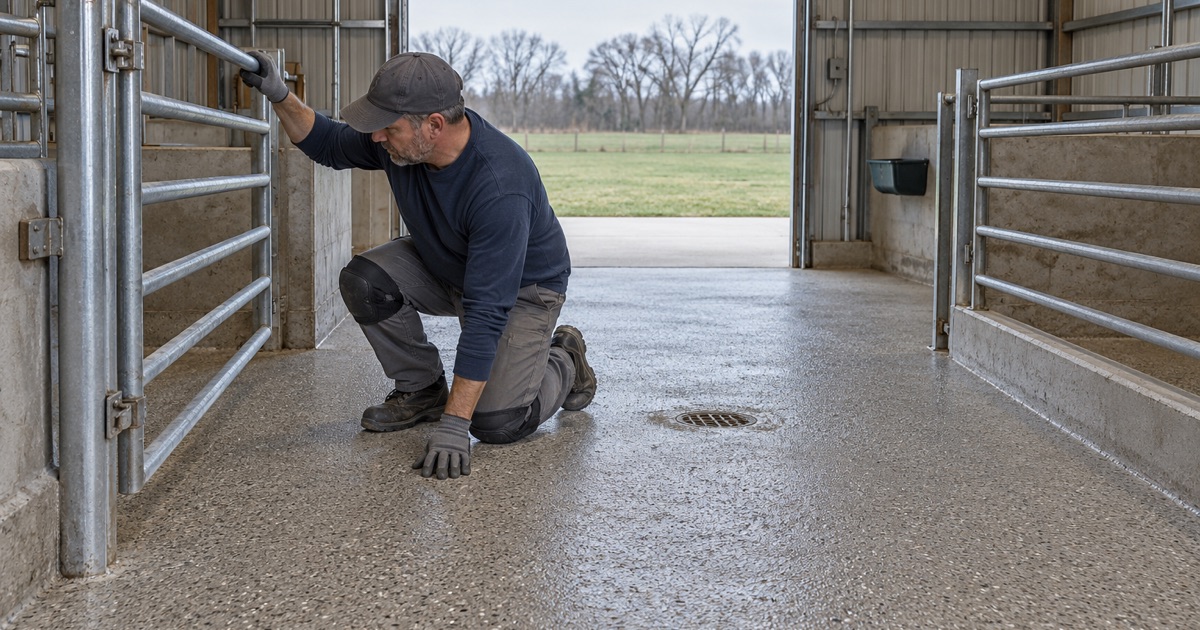
A smooth, wet resin floor is no place for a goat. Hooves need bite, so we broadcast quartz aggregate into the base coat and lock it in with the topcoat, tuning the grit to the animal and the cleaning routine. Coarser texture grips better but holds more waste, and finding that balance is part of every barn proposal.
Vinyl flake broadcast is a fine choice in a garage, but on its own it offers less grip than quartz for animals on a wet floor. Some owners lay rubber mats in resting areas over a coated aisle, which works as long as the mats are lifted and the floor beneath them is washed. We plan the texture around how the barn is actually cleaned.
Goat Yoga and Visitors Underfoot
Elawa Farm’s 2026 calendar runs Goat Yoga through October 31, a program in which goats crawl over people doing yoga. Wherever animals and visitors share a floor like that, it has to be safe for shoes and bare hands as well as hooves. That pushes the choice toward a moderate texture that still wipes clean.
Polyaspartic and polyurea topcoats cure quickly and resist abrasion, which helps when a space has to reopen soon. We confirm the topcoat’s recoat and traffic times with the owner before the job is scheduled. Animals and people then return to a fully cured surface rather than a tacky one.
Coops, Kennels and Potting Sheds at Home
Backyard Coops and Kennel Runs
Most Lake Forest homes are detached houses, and where an owner keeps a backyard coop, a dog run or a small outbuilding, its slab faces a smaller version of the barn problem. Poultry litter and dog urine put the same kind of acid on concrete, just in smaller amounts. A coated floor there is mostly about how quickly the space can be scraped, hosed and dried.
We grind and coat these the same way as a larger barn, with a textured surface and a cove at the walls where it is practical. On a small floor, the edges and the drain matter more than the square footage. A sloppy edge is where litter packs in and the coating starts to lift.
Potting Sheds and Garden Workrooms
A potting shed floor sees wet soil, fertilizer, spilled water and dragged terracotta pots rather than manure. It needs the same moisture test and mechanical profile, but usually a lighter texture, since nobody on hooves is standing on it. Quartz or flake in the broadcast still keeps a wet floor from turning slick underfoot.
Fertilizer salts and hose water run off potting benches all season, and a seamless resin floor keeps them out of the slab. Where an owner only wants to harden and dust-proof bare concrete, a lithium silicate densifier is the lower-cost option, and we lay out that tradeoff plainly.
Permits, Products and the Illinois Line
Illinois licenses no flooring or coating contractor, so we confirm with the City of Lake Forest Community Development Department whether a job calls for a permit before it is scheduled. Lake Forest sits on the Illinois side of the state line, where state rules cap the VOC content of the architectural coatings an installer may apply. Every product we choose here meets that limit.
Grinding dust and slurry are collected on site and never washed toward a street drain, a ditch or the lake. Around animals that matters twice, because residue left in a barn ends up on hooves and in feed. Every residential job also carries a written contract before any deposit, with the products and warranty terms spelled out.
- 20+ Years on Concrete
- Moisture Tested First
- Written System Proposals