Kenosha Epoxy Flooring has spent more than 20 years on epoxy flooring in Gurnee and across the state line, and the question we hear most here is not about color or flake. It is about water. Owners want to know what happens to a coated slab when the river comes up, and whether the finish they choose will still be there after the cleanup.
That is a fair question, and it has a documented answer. A federal bulletin rates common floor finishes for how well they survive contact with floodwater, and formed-in-place epoxy is on the favorable side of that list. What the rating covers, and what it never covers, is what this page is about.
We will walk through how the rating works, why some familiar finishes fail it, and what our crew does on a Gurnee slab before any coating goes down. Every proposal we write names the product, the system build and the finished thickness, so the floor you were quoted is the floor you can check.
Thirty-Four Buildings Bought Out of the Floodway
The Des Plaines River runs through the village, and Gurnee has been dealing with it in a direct way for decades. Rather than keep repairing the same structures after every flood, the village has bought buildings out of the floodway and cleared the land. That history explains why floor finishes below the flood level are a real conversation here rather than a theoretical one.
Buyouts since 1987
As reported in 2023, the village counted 34 buildings acquired and removed from the floodplain since 1987. Sixteen of them, mostly homes on Kilbourne Road and Emerald Avenue, were razed from 2011 onward. The money came from federal and state grants along with village funds.
We repeat those figures as they were reported and do not stretch them. They describe a community that decided some structures could not be kept dry, and that the better long-term answer was to take them out of the water’s path entirely.
Gurnee Grade School, 1954 to 2013
The clearest example is Gurnee Grade School, which opened in 1954 on a site built in a floodway. It flooded consistently, and Lake County’s stormwater agency put each flood’s response, including sandbagging, relocating students and cleanup, at about $300,000. The school closed in January 2013 and roughly 450 students were relocated.
Lake County then used $3.2 million in federal disaster funds, distributed by the Illinois Department of Commerce and Economic Opportunity, to buy and demolish the school and its maintenance building on 5.76 acres. Demolition began in late September 2013. The site at 900 Kilbourne Road became Viking Park West and was transferred to the Gurnee Park District in 2023.
The 2017 crest
The river made the point again on July 15, 2017, when the Gurnee gage crested at 12.09 feet. That topped the previous record of 11.95 feet set on September 27, 1986. Roughly 100 homes and 16 businesses in Gurnee were reported flooded, and one of the village’s firehouses was shut by the water.
Looking for epoxy-flooring closer to Lake Villa? See Lake Villa Epoxy-Flooring.
How FEMA Rates a Floor Finish for Flood Damage
The National Flood Insurance Program publishes guidance on which building materials hold up when floodwater reaches them. For floors, the relevant document is FEMA’s Technical Bulletin 2, and its finish table is the most useful single reference we know of for a slab that sits below the flood level.
What Table 2 measures
The January 22, 2025 edition of Technical Bulletin 2 carries a table titled Common Finish Materials, Uses, and Flood Damage-Resistance Ratings. Each finish is marked Acceptable or Unacceptable. The test behind the label is whether the material can survive direct contact with floodwater and then be cleaned, rather than torn out and replaced.
That is a narrower idea than most people expect. The table does not ask whether a finish keeps water from reaching the slab or the room. It asks whether the finish is still serviceable once the water leaves and the mud has been washed off.
The 2025 edition and stricter local rules
The 2025 bulletin replaces the 2008 edition, so older guidance a homeowner may have read online is out of date. The bulletin also states that community requirements stricter than the NFIP minimum take precedence over it.
In practice that means the federal table sets a floor, not a ceiling. If a local rule asks for more on a particular property, the local rule governs, and we work to whatever the reviewing office requires.
Who decides the flood level
Whether a given floor actually sits below the flood level is not something a coating contractor decides. That call belongs to the community’s floodplain administrator, working from the official maps and the property’s elevation.
We will not tell you your slab is in or out of the floodplain. What we can do is explain how the finish ratings apply once that question has been answered by the people whose job it is to answer it.
Formed-in-Place Epoxy Rated Acceptable, Linoleum and Adhesive Tile Not
Table 2 sorts familiar floor finishes into two camps, and the dividing line is mostly about what holds the finish to the slab. Finishes that rely on a water-sensitive bond, or that trap water within themselves, tend to land on the wrong side.
Why formed-in-place epoxy passes
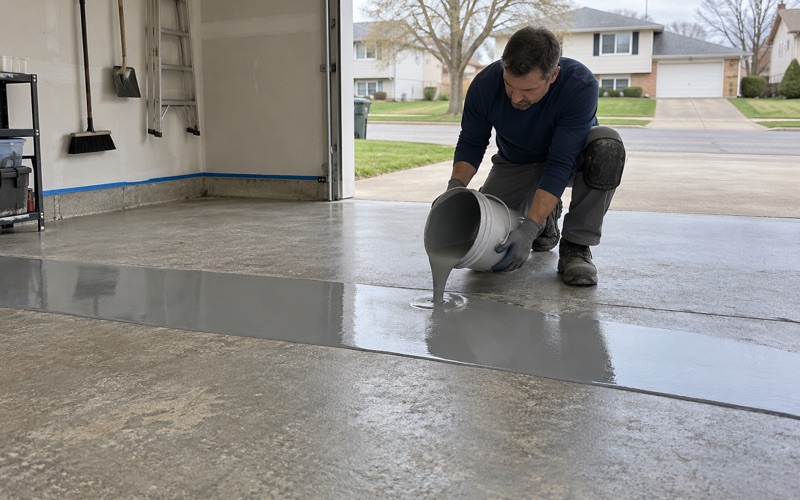
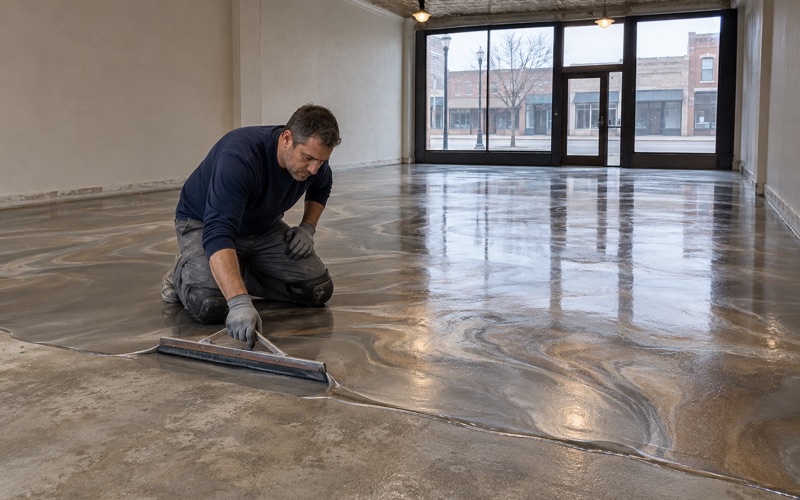
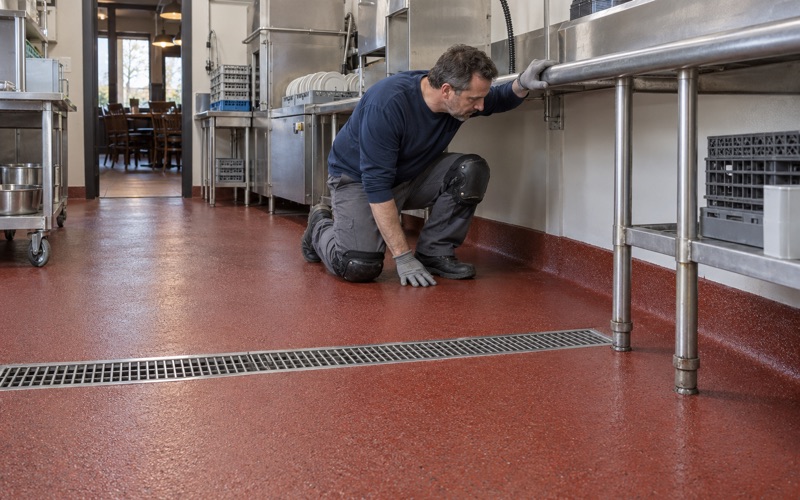
The bulletin lists epoxy flooring, formed-in-place, as Acceptable. Formed-in-place means the coating is mixed and applied as a liquid that cures into a continuous film on the slab itself. There is no separate adhesive layer and no seams for water to run beneath.
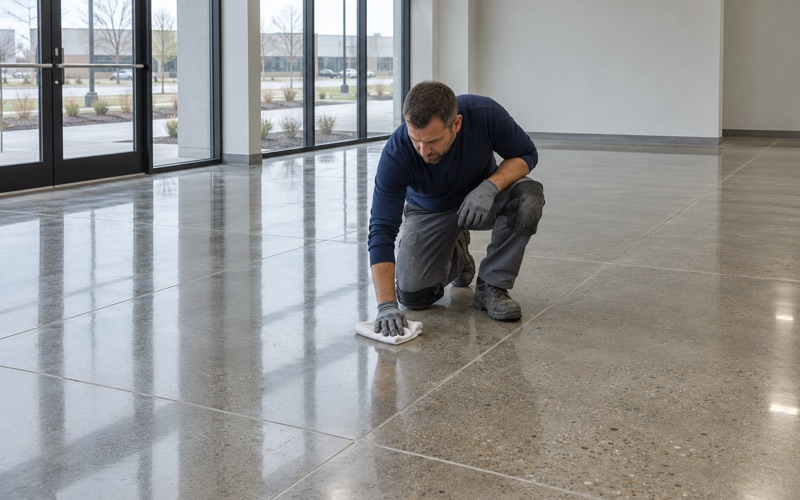
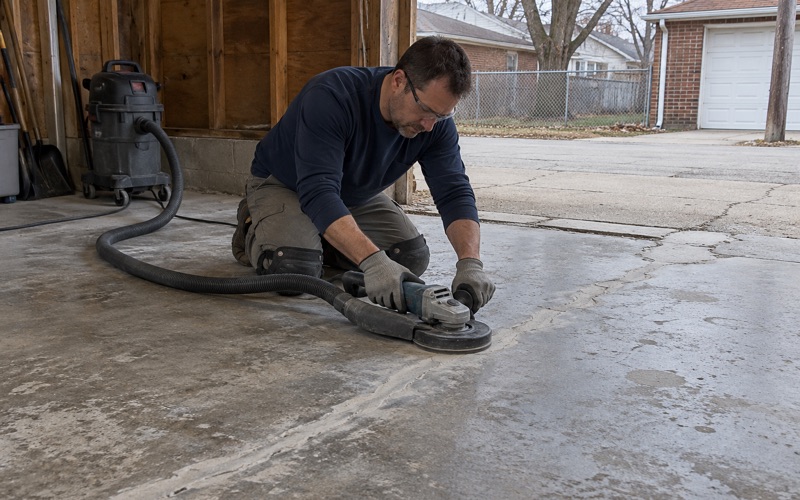
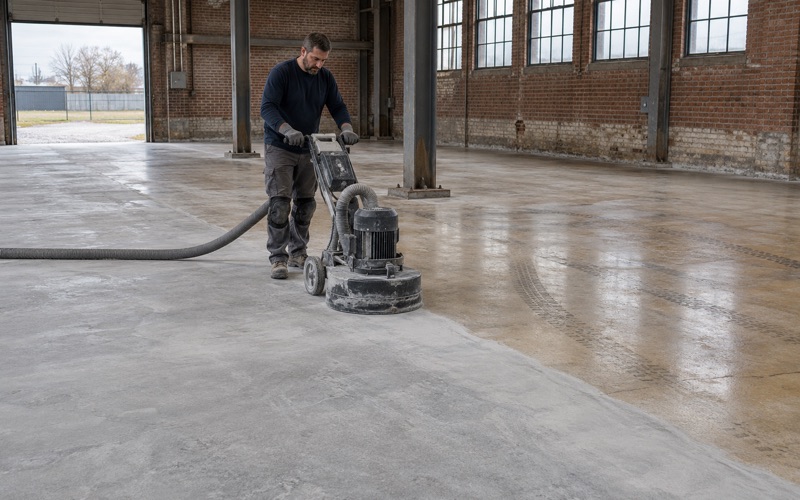
That continuous bond is why surface preparation matters so much. We open every slab mechanically with a diamond grinder or shot blaster to an ICRI concrete surface profile suited to the system, and we never acid etch. A 100% solids epoxy base bonded to a properly profiled slab is what formed-in-place flooring is meant to be.
Unacceptable: linoleum, asphalt tile and carpet
On the other side of the table, carpeting, linoleum and asphalt tile are all rated Unacceptable. Ceramic and porcelain tile split by how they are set. With a mortar bed they are Acceptable, but set in organic adhesives they are Unacceptable, and concrete tile with a mortar set is Acceptable.
The pattern is consistent. Where an organic glue or a fibrous layer stands between the finish and the slab, floodwater tends to break the bond or soak in, and the finish comes up during cleanup. A slab carrying one of those finishes often has to be stripped before anything else can happen.
What we put in the proposal
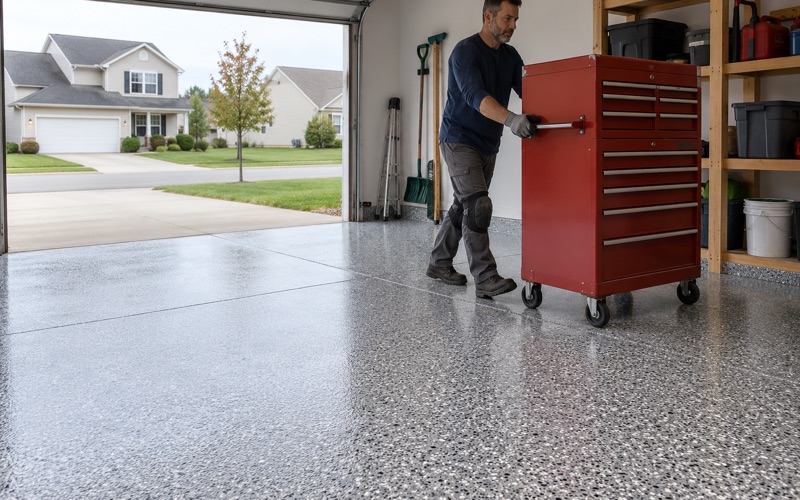
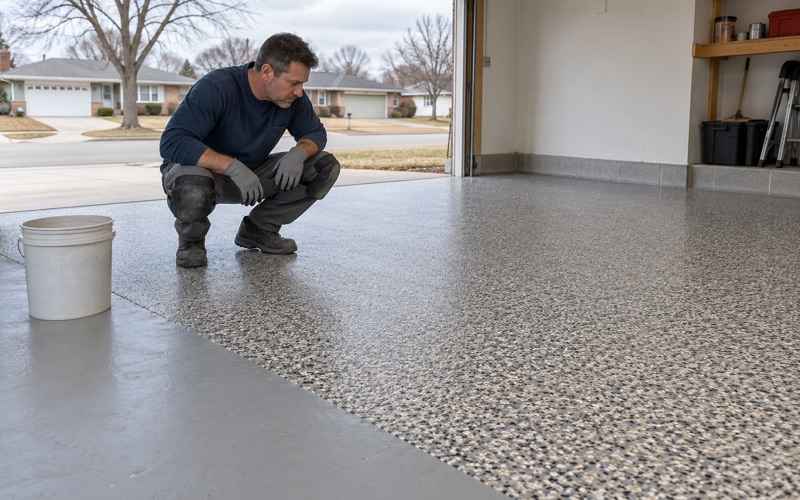
Because the rating attaches to a material type, we write that material into the paperwork. Our proposal names the epoxy product, whether a quartz aggregate or vinyl flake broadcast is included, the topcoat, and the finished thickness. You can hold that page against what went down on the floor.
We also read the cracks, joints and any old coating before we quote. If an existing adhesive finish or a failing coating has to come off first, or if the slab needs repair before it can be coated, we say so in writing.
Flood-Resistant Is Not Waterproof: What Still Has to Happen After Water
An Acceptable rating is good news for a floor that may see floodwater, but it is easy to read more into it than the bulletin says. We would rather set that expectation clearly before the job than explain it after the river has come and gone.
What the rating does not promise
The rating describes a material, never an installer, and it says nothing about keeping water out of a building. A coated slab can still be submerged, and water can still reach it through walls, openings and the slab’s own edges. Epoxy is also a film that follows the concrete under it, so a crack that moves will show through.
There is no such thing as FEMA approval for a contractor, and Illinois licenses no flooring or coatings contractor at all. Nobody can honestly sell you a floor with a federal seal on it. What you can buy is a finish type the bulletin rates favorably, installed over a slab that was prepared and tested properly.
Testing the slab before we coat it
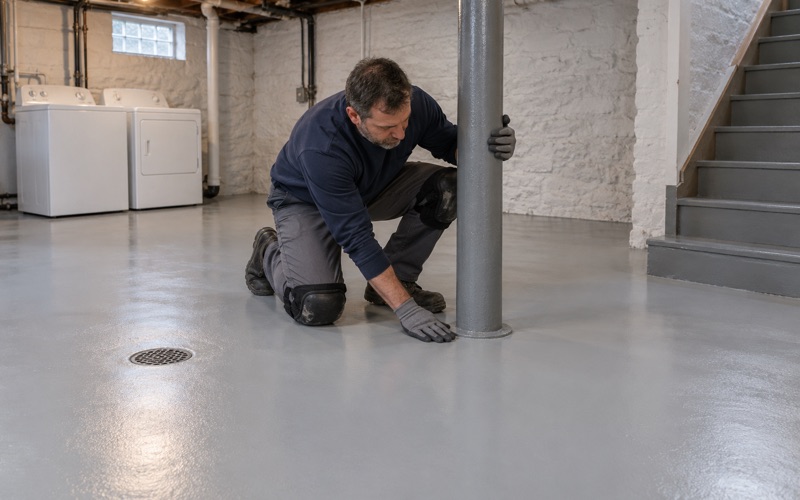
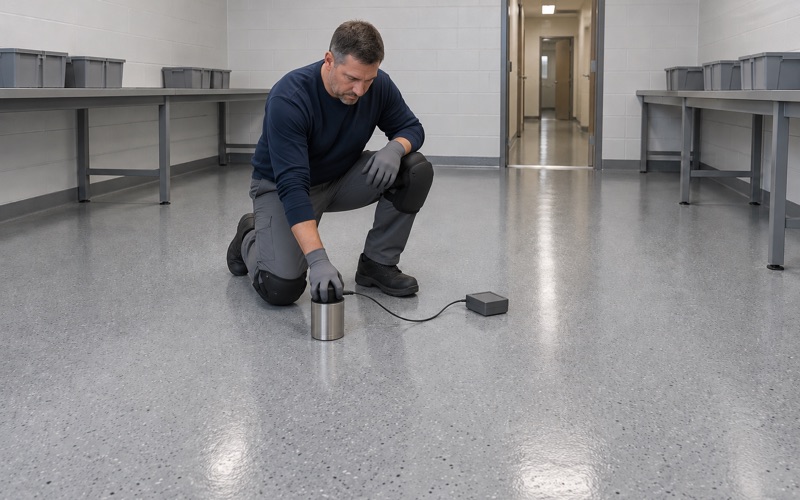
Moisture testing is a line item in every scope we write, on a basement slab and a garage slab alike. Depending on the slab, that means an ASTM F2170 in-situ relative humidity probe, an ASTM F1869 calcium chloride test, or both, read against the coating manufacturer’s limits.
If the numbers are high, we discuss a moisture-mitigation primer or waiting, and we read the warranty exclusions out before the job is sold, with moisture named first. After a flood, a slab that has been underwater needs that testing again before any recoat or repair goes on it.
Cleanup, curing and the paperwork
Grinding dust and slurry are collected on site and never washed toward a street drain or the river. Curing is scheduled against slab temperature and the dew point spread at the surface rather than the calendar, which protects the bond the whole system depends on.
On the Illinois side we apply coatings that meet the state’s limits on VOC content. Gurnee’s published contractor registration list covers electricians, plumbers, HVAC contractors and roofers but not coating work, so we hand you our insurance certificate directly and put the products and any warranty in the written agreement.
- 20+ Years on Concrete
- Moisture Tested First
- Written System Proposals