
Kenosha Epoxy Flooring installs epoxy garage floors in Kenosha, WI, serving surrounding cities including Somers, Pleasant Prairie, Bristol, Sturtevant and Winthrop Harbor. With 20+ years on concrete, we build garage floors the slow way at the start so they last at the finish: the slab is ground open, tested for moisture and repaired before the first coat of epoxy goes down.
A garage floor in this part of Wisconsin takes more abuse than most rooms in a house. Every winter, road salt and calcium chloride brine drip off the tires and sit on the concrete for months, and in summer a hot tire pulled straight off the highway tests how well a coating is bonded. We choose the base coat, broadcast and topcoat around both of those conditions.
Before any work starts, you get a written proposal and contract naming the product, the system build and the finished thickness. That way the floor we quoted is the floor you can check against what went down, and the exclusions in any warranty are read out ahead of time, moisture first.
Choosing an Epoxy Garage Floor System
Full Flake Epoxy With a Polyaspartic Topcoat
Our most requested garage system pairs a 100% solids epoxy base coat with a full vinyl flake broadcast and a clear polyaspartic topcoat. The epoxy builds thickness and bond to the ground slab, the flake hides dust and tire marks and adds a little texture, and the polyaspartic top resists hot tire pickup and does not amber in the sunlight that comes in through an open door.
Solid Color and Quartz Garage Coatings
Not every garage needs flake. A solid color epoxy with a durable topcoat suits a workshop or a car enthusiast who wants a clean, bright surface for spotting dropped parts. Where grip matters most, such as a garage that doubles as a mudroom, a quartz aggregate broadcast gives texture and color in one step and stands up well to boots, shovels and snowblowers.
Why Store-Bought Garage Kits Peel
Most retail garage floor kits are thin water-based coatings applied over acid-etched concrete. They look good for a season, then lift where tires sit, because the bond was never strong and the film is too thin to resist a hot tire. When we remove a failed kit, the concrete underneath usually shows that the etch never opened the surface evenly.
Metallic Epoxy for a Showroom Garage
Some owners want the garage to look like a showroom, and a metallic epoxy system delivers a marbled, deep finish that no two floors share. It is less forgiving than flake, because every low spot and trowel mark in the slab shows through, so we spend more time on grinding and patching first. We also discuss honestly how it will look after a few winters of salt, sand and tire traffic.
What Kenosha Garage Slabs Need Before a Coating
Moisture Under an Attached Garage Slab
Wisconsin’s dwelling code requires a vapor retarder beneath a home’s floor slab but exempts the slab of an unconditioned attached garage, under SPS 322.38. Plenty of garage floors in the area therefore sit directly on fill with no sheet under them. We test the slab with an ASTM F1869 calcium chloride kit or ASTM F2170 relative humidity probes and choose the primer from the reading rather than from how dry the floor looks.
Cracks, Spalls and Salt Scaling
Garage slabs here often show salt scaling near the door, spalled edges at the apron and shrinkage cracks across the middle. We fill and repair those before coating so the finished floor is smooth and sealed. A crack that is still moving is different, and we say so plainly, because a coating is a thin film that follows the concrete and cannot hold a shifting slab together.
The Floor the Dwelling Code Already Requires
SPS 321.203 sets out what a Wisconsin garage floor must be: noncombustible, impermeable to petroleum, at least 4 inches thick over granular fill and sloped toward the door or a floor drain. The code does not require sealing the concrete. That leaves the coating as an owner’s decision, and we keep the existing slope intact so meltwater still runs where the code intended.
Our Step-by-Step Epoxy Garage Floor Process
Step 1: Walk the Slab and Write the Scope
We look at every crack, joint, drain and patch of old coating, test for moisture and measure the space. From that we write a scope that names each repair, the primer, the base coat, the broadcast, the topcoat and the finished thickness, with the price tied to each line.
Step 2: Grind and Repair
The slab is opened with a diamond grinder to the surface profile the system calls for, edges included, with dust collected by vacuum as we go. Cracks, spalls and pits are filled with repair material and ground flush so the coating goes down over a flat, sound surface. Grinding dust and repair slurry are collected and bagged on site, never rinsed down the driveway toward a street drain or the lake.
Step 3: Prime, Coat and Broadcast
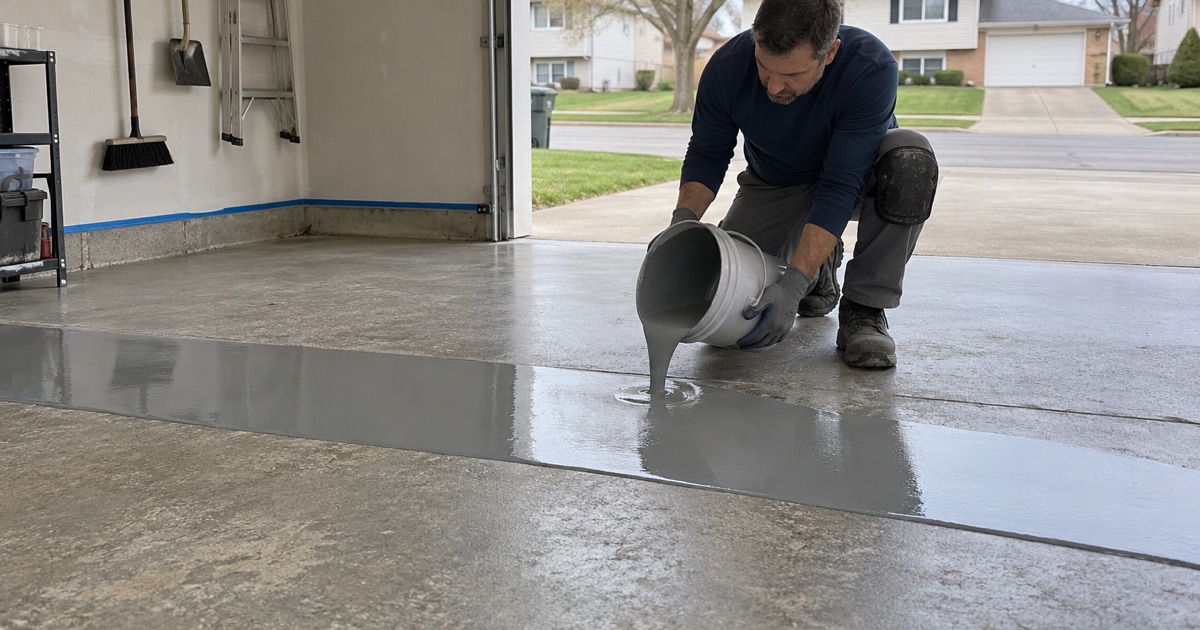
We apply the primer or base coat at a measured rate, then broadcast flake or quartz into it while it is wet. Before each coat we check slab temperature against the dew point at the surface, because coating a slab that is too cold or too close to the dew point invites amine blush and a weak bond.
Step 4: Scrape, Topcoat and Cure
Once the broadcast has set, the loose chips are scraped and vacuumed and the topcoat seals everything in. We leave you with the walk-on and drive-on times, care instructions and the written record of what was installed.
Living With a Coated Garage Floor
Winter Salt and Brine on a Coated Floor
A coated floor keeps chloride on the surface where it can be squeegeed to the drain or out the door, instead of letting it soak in and scale the concrete. Rinsing the floor a few times through the winter keeps salt residue from dulling the topcoat. The difference from a bare slab is easiest to see by the third or fourth spring.
Hot Tires, Jack Stands and Dropped Tools
Polyaspartic topcoats over a well-bonded epoxy base stand up to hot tires, rolling toolboxes and normal shop use. Point loads such as jack stands can mark any coating, so we suggest a small plate under them. A dropped wrench may chip the finish, and flake floors make those spots easy to touch up.
What a Garage Coating Warranty Leaves Out
Most product warranties exclude failures caused by moisture vapor rising through the slab, by slab movement and by damage from outside the coating. We explain those exclusions before the job is sold, which is one more reason the moisture test is written into every garage scope rather than offered after a problem appears.
Contracts, Deposits and the Written Record
Wisconsin’s home improvement rule, ATCP 110, governs how home improvement work is contracted, and we put every garage job in a written contract before any deposit is taken. The contract lists the products by name, the system build, the finished thickness and any warranty terms. Keep it with your house papers, because it tells a future buyer or contractor exactly what is on the floor.
- 20+ Years on Concrete
- Moisture Tested First
- Written System Proposals