
Kenosha Epoxy Flooring installs ESD flooring in Kenosha, WI, serving surrounding cities including Somers, Pleasant Prairie, Bristol, Sturtevant and Winthrop Harbor. In 20+ years of commercial floor work, we have learned that an electrostatic discharge floor is less about the coating in the bucket and more about the grounding, preparation and testing that make the coating do its job.
Static-dissipative and conductive floors are built for electronics assembly, testing labs, data rooms, and other spaces where a stray static discharge can damage sensitive components or disrupt equipment. They look like other resinous floors, but they carry charge from people and carts safely to ground instead of letting it build up.
We start from your specification and your ESD control program, then write a proposal that names the system, the grounding layout, the finished thickness and how the floor will be tested after installation. Work can be scheduled around production, including overnight and weekend windows.
How ESD Flooring Works
Conductive Versus Static-Dissipative
ESD floors fall into two broad classes. Under the ESD Association’s resistance test method, STM7.1, conductive flooring measures at or below 1.0 x 10^6 ohms, and static-dissipative flooring measures above that range. Conductive floors move charge faster, while dissipative floors bleed it off in a more controlled way.
The right class depends on what you handle and on your facility’s ESD plan. Some spaces specify conductive floors near the most sensitive work, with dissipative floors in surrounding areas. We build to the specification rather than choosing for you.
The System View in ANSI/ESD S20.20
ANSI/ESD S20.20 treats the floor as one part of a system that includes the person, their footwear and the floor together. For flooring used as a primary grounding path, the standard sets two requirements: the resistance of a person wearing footwear while standing on the floor must be less than 1.0 x 10^9 ohms, and the body voltage generated while walking must stay under 100 volts.
Meeting those numbers depends on footwear and procedures as much as on the floor. We coordinate with your ESD coordinator so the floor and the footwear program are planned together.
Grounding Points and Conductive Layers
An ESD floor carries charge through conductive elements in the coating to copper strips or grounding points tied to building ground. The number and location of grounding points are laid out before installation. A conductive primer or layer beneath the topcoat helps distribute charge evenly across the floor.
If grounding is skipped or poorly placed, an ESD coating can test well in one spot and poorly a few feet away. Planning the layout is the part of the job that makes the floor consistent.
Where ESD Floors Are Used
Electronics Assembly and Repair
Circuit board assembly, electronics repair and component handling areas are the classic ESD floor applications. The floor works with heel straps or ESD footwear, grounded benches and wrist straps to keep charge from reaching sensitive parts.
Assembly areas also see carts, chairs and frequent cleaning. We choose a topcoat that holds its electrical properties under that wear and plan joints and transitions so the conductive path stays continuous between rooms.
Labs, Clean Areas and Test Rooms
Laboratories and test rooms often combine ESD requirements with chemical resistance and cleanability. Seamless resin floors with coved edges suit these spaces, and the ESD properties can be built into a system that also handles spills and frequent cleaning.
Data Rooms and Control Rooms
Server rooms, network closets and control rooms benefit from flooring that limits static buildup around sensitive equipment. In these spaces, the schedule is often tighter than the floor area, and we plan work around equipment that cannot be shut down.
Dust control is especially important near running servers. We grind with vacuum collection, seal off the work area and use low-odor products where air is recirculated, so the preparation does not create a problem for the equipment the floor is meant to protect.
Installing ESD Flooring Correctly
Surface Preparation
Like every coating we install, an ESD floor starts with mechanical preparation. We grind or shot blast the slab to the profile the system requires, remove old coatings and contaminants and repair cracks and joints. We never acid etch. Old insulating coatings left under an ESD floor can interfere with the conductive path, so removal is usually more thorough than for a standard coating.
Moisture and Slab Condition
Moisture coming through a slab can affect both the bond and the electrical behavior of some systems. We test the slab with calcium chloride kits or relative humidity probes before installation and use a moisture-tolerant primer when readings call for it, following the manufacturer’s requirements.
We also read cracks and joints during preparation. A coating is a film that follows the slab beneath it, so an active crack can break both the surface and the conductive layer. Where a slab is moving, we say so before quoting and plan repairs first.
Testing and Documentation
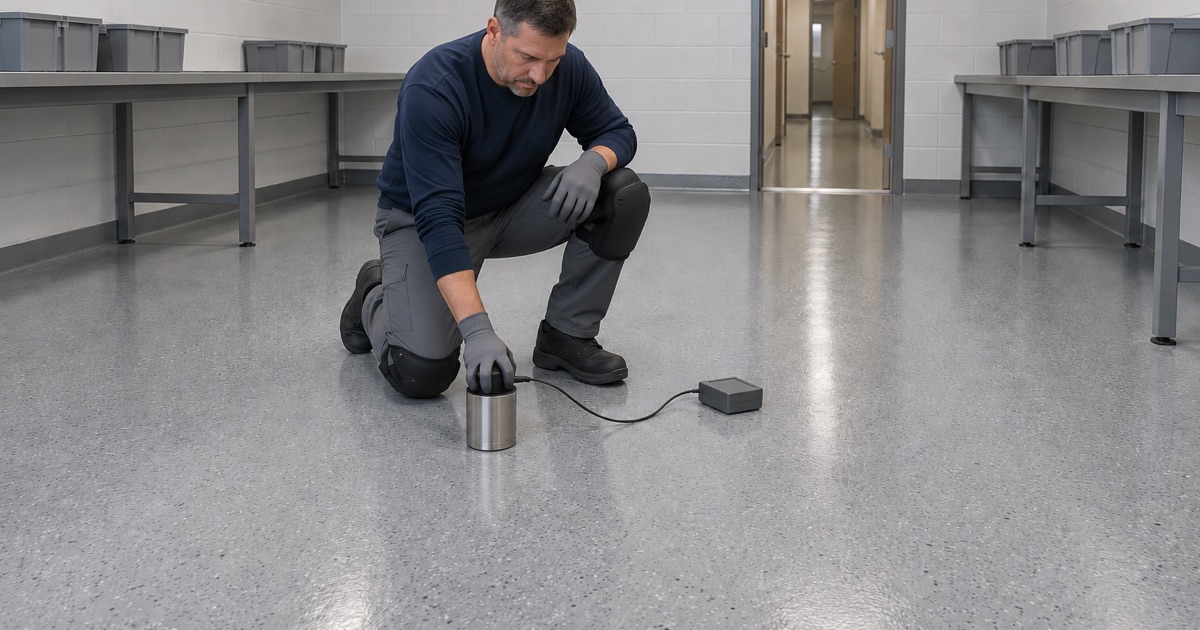
After the floor cures, we test resistance across the area using the method your specification names and record the readings. Where your program requires it, a system test with personnel and footwear can follow. You receive the results along with the product data for your files.
Living With an ESD Floor
Cleaning and Maintenance
ESD floors need cleaners approved for them. Waxes, floor finishes and some general-purpose cleaners leave an insulating film that raises resistance over time. We hand over the manufacturer’s maintenance guidance and can retest the floor periodically if your program calls for it.
Footwear and Carts
The floor protects only what is connected to it. ESD footwear, heel straps and conductive casters on carts complete the path to ground. We are glad to talk through how your existing footwear and equipment will interact with the new floor before installation.
Repairs and Changes
If equipment is moved or the floor is damaged, repairs need to restore both the surface and the conductive path. We repair ESD floors with compatible materials and retest the repaired area so the floor stays within specification.
For facilities on the Illinois side of our service area, we select ESD systems that meet the state’s VOC limits for architectural coatings under 35 Ill. Adm. Code Part 223. Wisconsin projects follow the federal rule on the manufacturer, and the proposal names the exact product for each site.
- 20+ Years on Concrete
- Moisture Tested First
- Written System Proposals