Kenosha Epoxy Flooring installs commercial epoxy flooring in Kenosha, WI, serving surrounding cities including Somers, Pleasant Prairie, Bristol, Sturtevant and Winthrop Harbor. Over 20+ years we have coated warehouse aisles, plant floors, service bays and shops, and the lesson from all of them is the same: a commercial floor is built around the building’s schedule and its traffic, not the other way around.
Kenosha’s freeway belt along I-94 holds distribution floors of enormous size, and the rest of the area is full of plants, repair shops, showrooms and institutional buildings. Each one puts different loads, chemicals and cleaning routines on its floor, and each one has hours it cannot afford to close.
Our proposals name the product, the system build and the finished thickness, along with a sequence that shows which areas will be out of service and when. Work can run overnight and on weekends, and grinding dust and slurry are collected on site rather than washed toward a drain.
Warehouse and Distribution Floors
Filling Joints Before Coating
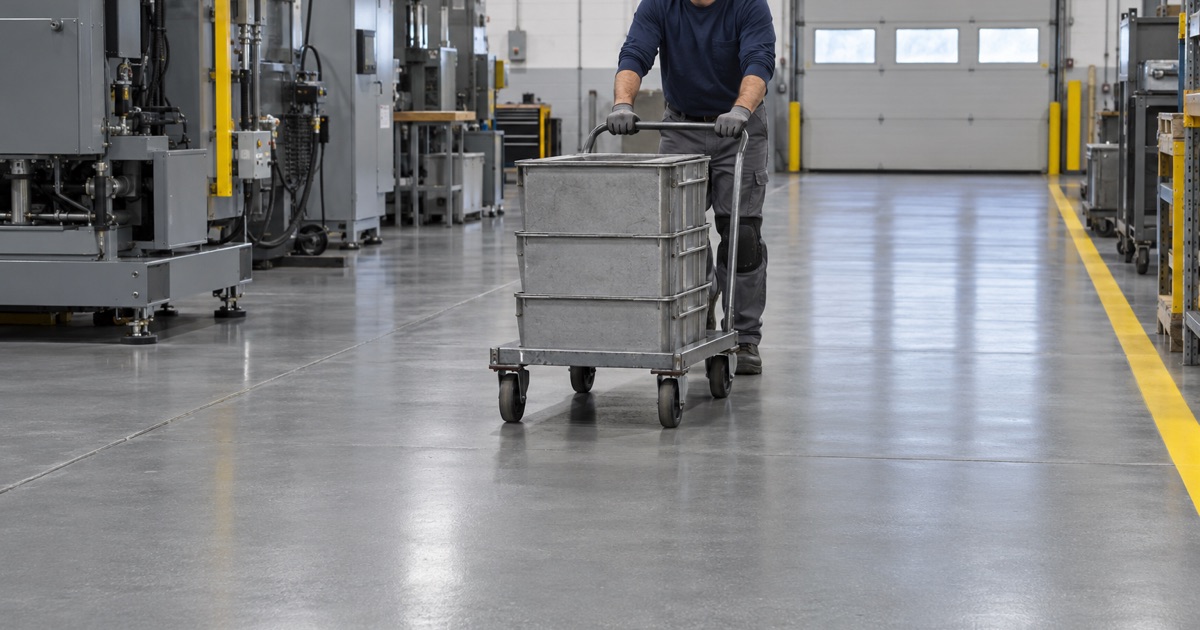
The saw-cut joints in a warehouse floor carry forklift and pallet-jack wheels all day. Industry guidance calls for a semirigid epoxy or polyurea joint filler to support the edges. We fill joints before any coating goes over them, because a coating bridged over an open joint cracks and spalls at the joint first.
Joint filling on its own also extends the life of an uncoated floor. In a building that is not ready for a full coating, filling and repairing the joints is often the most valuable first step.
Heavy-Build Epoxy for Forklift Aisles
Forklift aisles need a thick, high-solids system that resists abrasion and impact. We use 100% solids epoxy at a measured film build, sometimes with a quartz broadcast for added toughness and texture. Turning areas and dock approaches see the most wear and may get extra build.
We also look at wheel type. Hard polyurethane wheels and steel casters wear floors differently, and the system is chosen with the actual fleet in mind.
Lines, Zones and Visibility
Aisle lines, pedestrian walkways and hazard zones are built into the coating rather than painted on later. Sealed under a clear topcoat, they last far longer than paint on bare concrete. A light-colored floor also reflects overhead lighting, which can brighten aisles between tall racks.
Manufacturing, Shop and Service Floors
Machine Shops and Fabrication Floors
Machine shops deal with cutting oil, coolant, metal chips and dropped parts. We specify chemical-resistant coatings and plan around equipment that cannot move, coating up to and around machine bases. Anchors are sealed so fluids do not work under the coating and lift it from below. Where welding or heavy grinding happens, we discuss which areas should stay bare concrete or get a tougher finish, because sparks and hot slag can mark any coating.
Automotive Service Bays
Service bays combine hot tires, oil, brake fluid, solvents and winter salt. A high-build epoxy base with a polyaspartic or polyurethane topcoat handles that mix, and a texture additive keeps the floor safe when it is wet. Trench drains are detailed so water and fluids reach them instead of sitting at the coating edge. We can coat one bay at a time so the shop keeps working, using fast-cure topcoats to shorten downtime.
Static-Sensitive and Clean Areas
Electronics assembly and testing areas may need static-dissipative or ESD flooring built to a specified resistance range, with grounding planned into the layout. Clean areas benefit from a seamless coating with coved edges that leave no gaps for dust to collect.
An ESD floor is tested after installation to confirm it falls inside the specified range, and the results go to you with the rest of the job records. Footwear, carts and cleaning products all affect how the floor performs, so we pass on the manufacturer’s maintenance guidance as well.
Food, Kitchen and Institutional Floors
Food Plants and ATCP 70
Wisconsin’s food processing plant rule, ATCP 70, expects floors that are smooth, durable and easy to clean. Food plants run hot water, sanitizers and heavy carts across their floors daily. We match the system to the products, temperatures and cleaning schedule, using urethane cement where thermal shock would break down an epoxy.
Commercial Kitchens
Restaurant and institutional kitchens in the county go through Kenosha County Public Health plan review, and the Wisconsin Food Code follows FDA guidance on coved junctures between floor and wall. We build coves and slope floors to drains so water and grease do not collect along the edges.
Kitchens rarely close for long, so we plan around service and often work overnight between the last cleanup and the morning prep. Urethane cement handles the hot water, steam cleaning and grease of a busy line better than a thin epoxy, and it tolerates more moisture in the slab beneath.
Schools, Clinics and Offices
Institutional buildings need floors that clean easily and can be installed with minimal disruption. We phase the work, use low-odor products where occupants are nearby and schedule around classes, appointments and office hours.
Corridors and lobbies see winter grit and meltwater at every entrance. A coating with a satin finish and slip-resistant texture near doors stays safer and hides wear better than high gloss, and walk-off mats at entries extend the life of the whole floor.
Planning a Commercial Floor Project
Moisture and Slab Condition
Commercial slabs can carry moisture problems just like homes, especially older slabs on grade without a vapor retarder. We test with calcium chloride kits or relative humidity probes and choose a moisture-mitigation primer where readings call for it. The results are written into the scope.
Illinois and Wisconsin VOC Rules
For facilities across the state line, Illinois limits the VOC content of coatings an installer may apply under 35 Ill. Adm. Code Part 223. In Wisconsin, the federal rule binds the manufacturer. We select products compliant with the rules where the building sits.
That matters for businesses with locations on both sides of the line. A product used on a Kenosha floor may not be the one we apply in Waukegan or Gurnee, and the proposal for each site names the specific product so facility managers can match it to their records.
Warranty and Maintenance
We read out warranty exclusions before the job is sold, moisture first, and leave a maintenance plan matched to your cleaning equipment. A coated floor that is cleaned and recoated on schedule lasts far longer than one left to wear through.
- 20+ Years on Concrete
- Moisture Tested First
- Written System Proposals