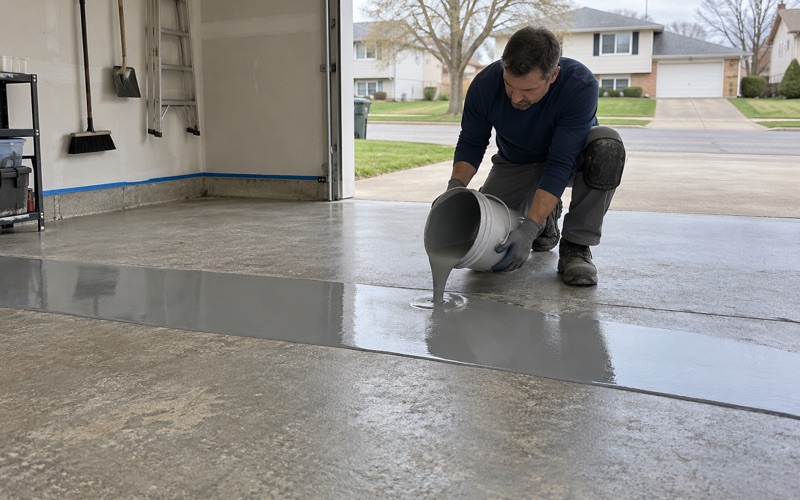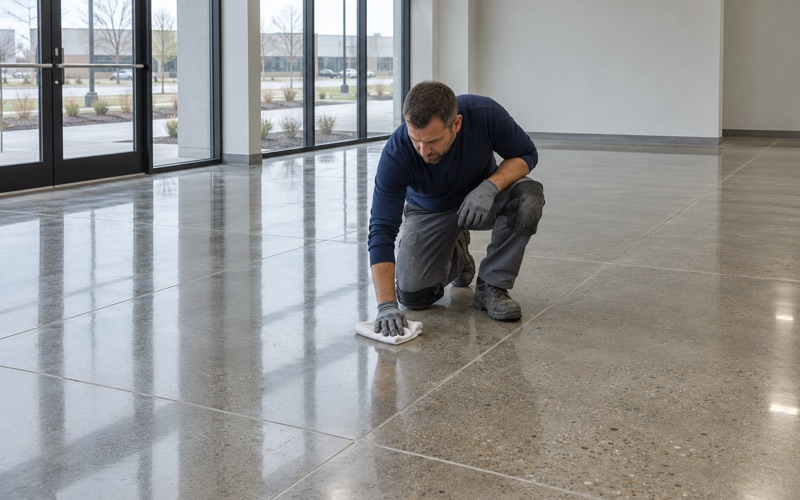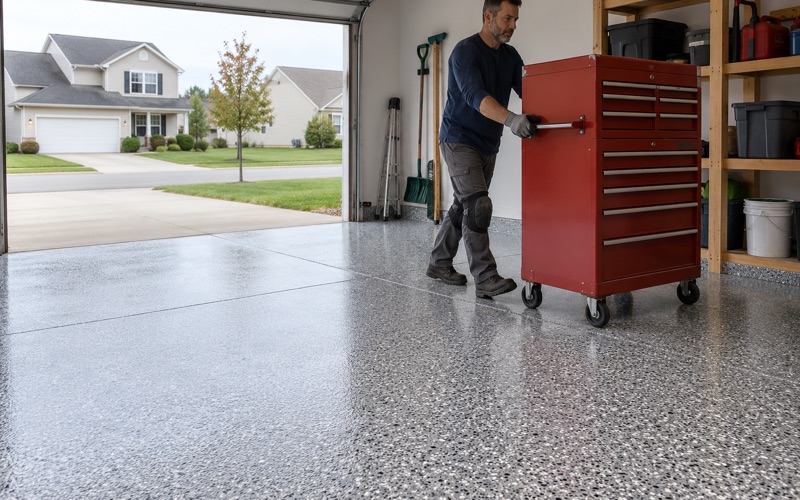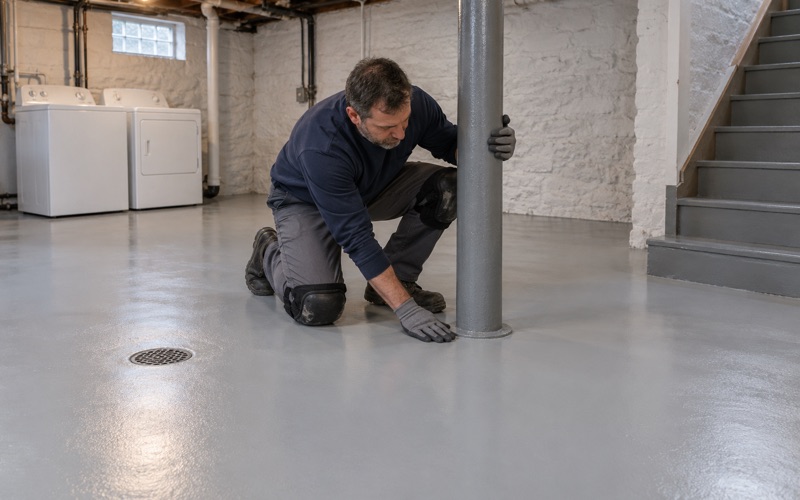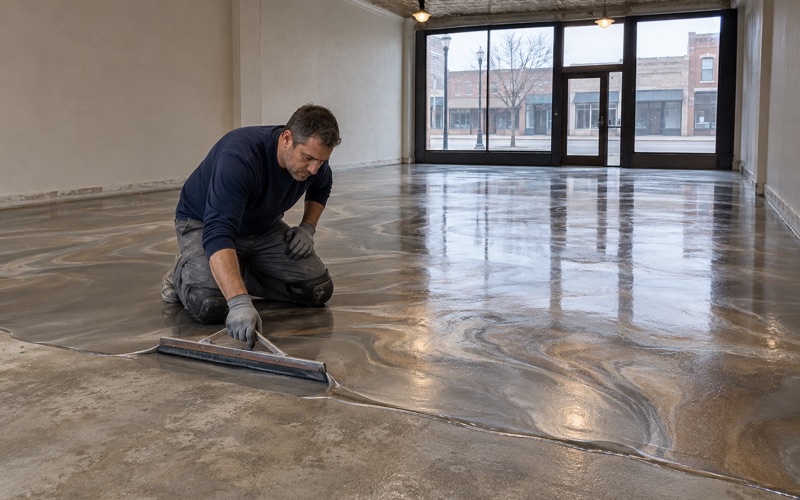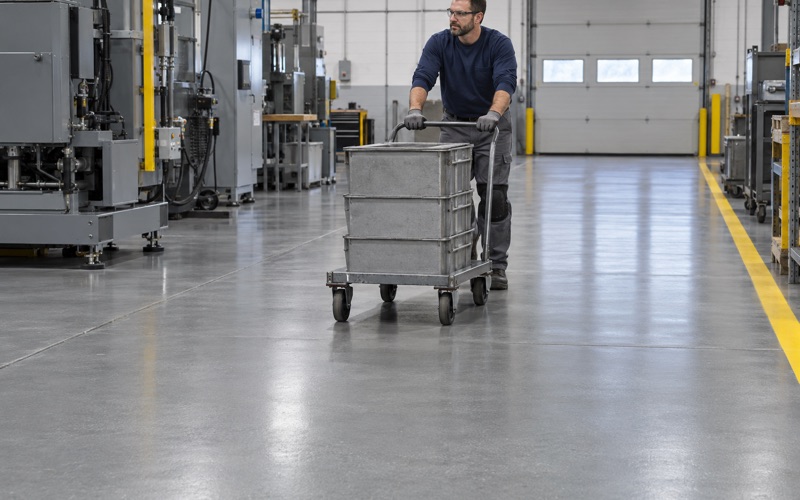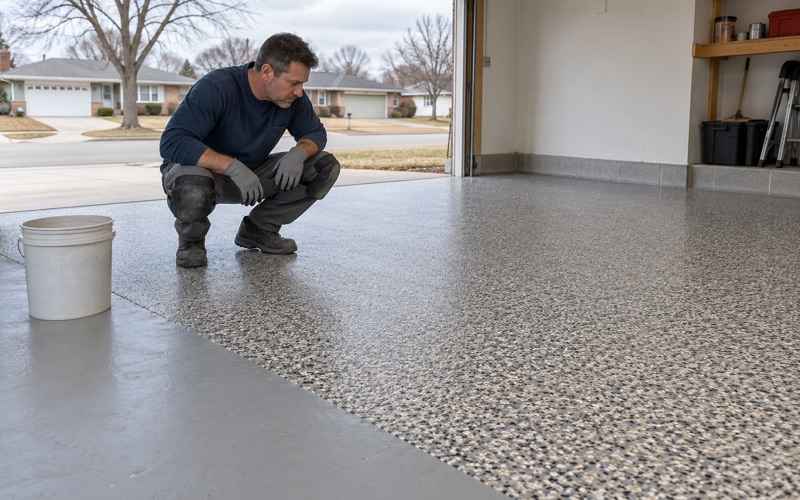
Kenosha Epoxy Flooring has spent more than 20 years on epoxy flooring in Caledonia and across southeastern Wisconsin, and the floors that teach the most are the ones washed down every shift. In a production room, a coating is judged less on how it looks at handover than on whether it still cleans the same way a year later. That is the standard we build to here.
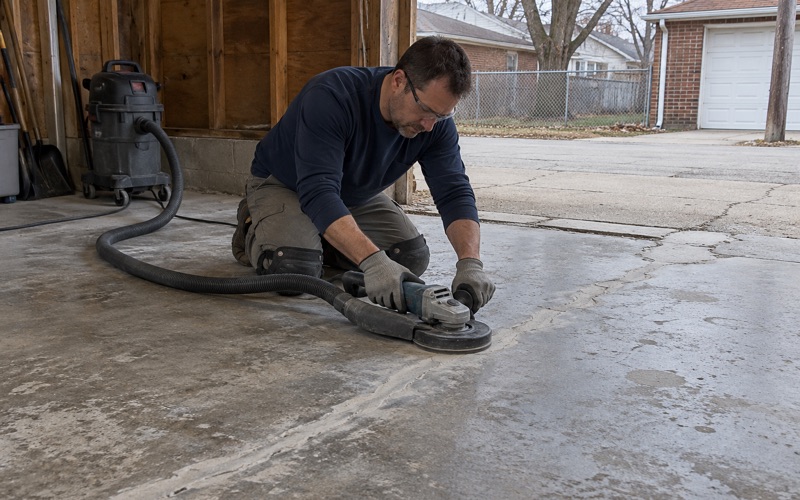
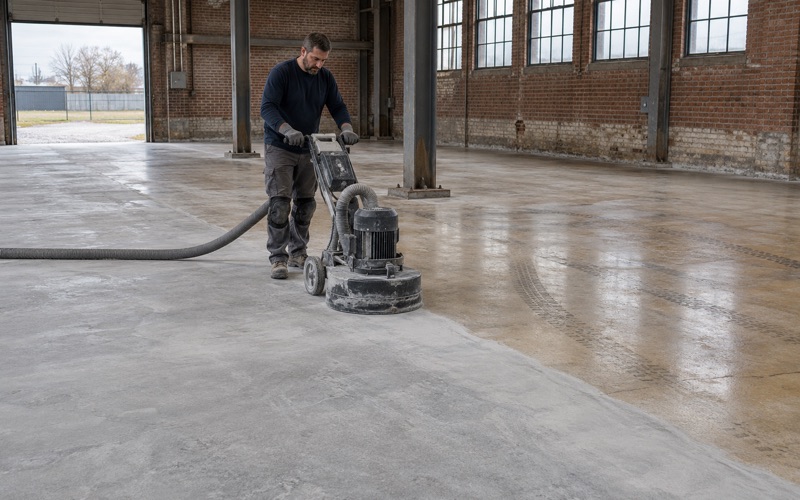
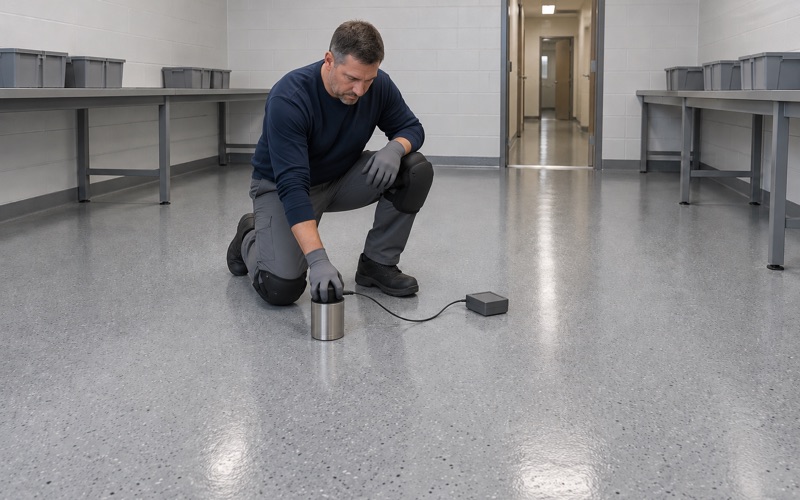
Every slab we coat is opened mechanically with a diamond grinder or shot blaster to a measured ICRI CSP profile, and we do not acid etch. Moisture testing is written into the scope as its own line, using ASTM F1869 calcium chloride kits or ASTM F2170 in-situ relative humidity probes, because a coating that lets go from below can no longer be cleaned or kept whole.
Our proposal names the product, the system build and the finished thickness, so a plant manager or a homeowner can check what was quoted against what went down. We also read the cracks, joints and any old coating before pricing anything. When a slab needs repair before it can carry a coating at all, we say so plainly.
What Good Repair Means on a Caledonia Production Floor
A Fermentation Plant on Nicholson Road
CSL USA operates an 80,000-square-foot custom fermentation facility at 4011 Nicholson Road, a Franksville mailing address that sits inside the Village of Caledonia. The plant produces food ingredients, bacterial cultures and probiotics for dairy, food, dietary supplements, pharma and agriculture. We mention it because it shows the kind of floor this village now asks for, not because we have worked there.
A plant whose cultures and probiotics go into dietary supplements answers to FDA’s current good manufacturing practice rule for supplements, 21 CFR Part 111. That rule is written for dietary-supplement manufacturing specifically. A bakery or a general food plant follows other rules, and we do not pretend one federal part governs every food floor.
What 21 CFR 111.20 Actually Says
Section 111.20(d)(1)(i) calls for floors, walls and ceilings that can be adequately cleaned and kept clean and in good repair. Section 111.20(a) asks that the physical plant be designed to facilitate maintenance, cleaning and sanitizing. Neither sentence names a product, a resin or a thickness.
That matters when someone tells a plant manager the FDA has signed off on a floor coating. The agency does not grant products that status, and no coating makes a plant compliant on its own. What a resinous system can do is give the plant a continuous, nonporous surface its own sanitation program can keep clean, for as long as the film stays whole.
Good Repair Is a Condition the Floor Has to Hold
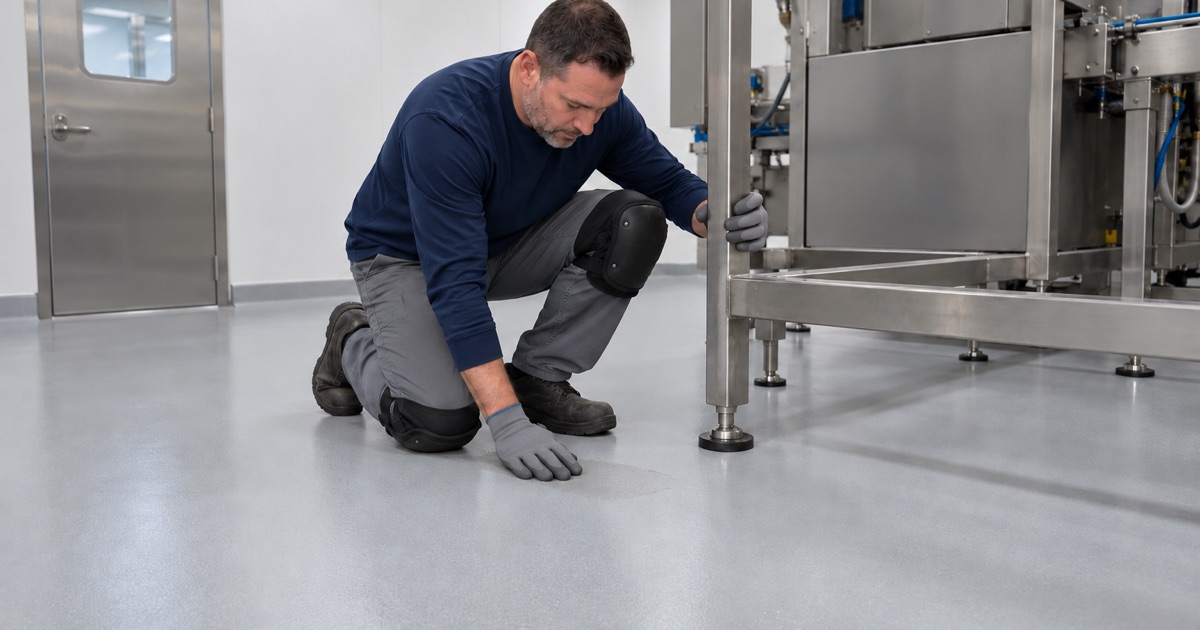
The phrase that carries the weight is kept clean and in good repair. A floor that looked perfect at handover and is chipped along the drain line two years later no longer meets the words of the rule. So the question we ask is not which coating is best, but which system will stay intact under this room’s traffic, temperature and washdown.
That often points toward a heavier build than a garage needs, such as a 100% solids epoxy body coat or a troweled urethane cement where hot water is part of the cleaning. We name the system and its finished thickness in writing, so the plant’s own maintenance team can hold us to it.
Looking for epoxy-flooring closer to Grandwood Park? See Grandwood Park Epoxy-Flooring.
Chips, Delamination and Open Joints
Why a Chip Becomes an Uncleanable Spot
A chip in a production-room floor is more than a cosmetic flaw. It exposes raw concrete with an open pore structure and leaves a broken edge where residue collects and a squeegee rides over instead of reaching in. That spot cannot be adequately cleaned, which is exactly the condition the supplement rule describes.
Chips usually start at impact points: where carts turn, where totes are set down, along the lip of a drain. We look for those zones on the walk-through and plan a thicker build or an aggregate-filled layer there. Coating the whole room to one uniform spec and hoping is how the first chip shows up in month three.
Delamination Starts Below the Film
When a coating peels in sheets, the cause is almost always under it rather than in it. A slab that was etched instead of ground, a surface still carrying old sealer, or moisture vapor pushing up from below will each release a film that looked fine for months. Once an edge lifts, rinse water and cleaning solution travel underneath and the failure spreads.
That is why moisture is tested before the quote is final, and why warranty exclusions are read aloud before the job is sold, with moisture named first. Where readings run high, a moisture-mitigation primer goes into the system rather than into a later argument. A plant manager deserves to know in advance what can undo the floor.
Open Joints and Cracks
Saw cuts and cracks are the other place a cleanable floor quietly stops being cleanable. An open joint holds water and residue below the level any cleaning tool reaches. We fill joints and rout cracks before a coating goes over them, using fillers chosen to stay bonded at the edge.
We also say plainly that a coating is a film that follows the slab beneath it. If a crack is still moving, the coating will mirror it, and no resin holds a moving slab together. Where a slab needs repair or replacement first, that goes into the proposal instead of under the coating.
Sanitation Chemicals, Condensate and Cure
Reading the Chart Against the Plant’s Own Cleaners
Every coating manufacturer publishes a chemical-resistance chart, and the useful version is the one compared line by line against the cleaners and sanitizers the plant actually uses. We ask for the sanitation chemical list, the concentrations and the water temperature before picking a system. A general promise of chemical resistance says nothing about how a topcoat behaves under this room’s routine.
Hot water matters as much as chemistry. Repeated hot washdowns put thermal stress through a thin film, and some topcoats soften or dull long before they fail outright. Where hot sanitation is routine, we lean toward systems rated for that heat rather than whichever coating is cheapest per square foot.
Condensate From Chilled Lines and Vessels
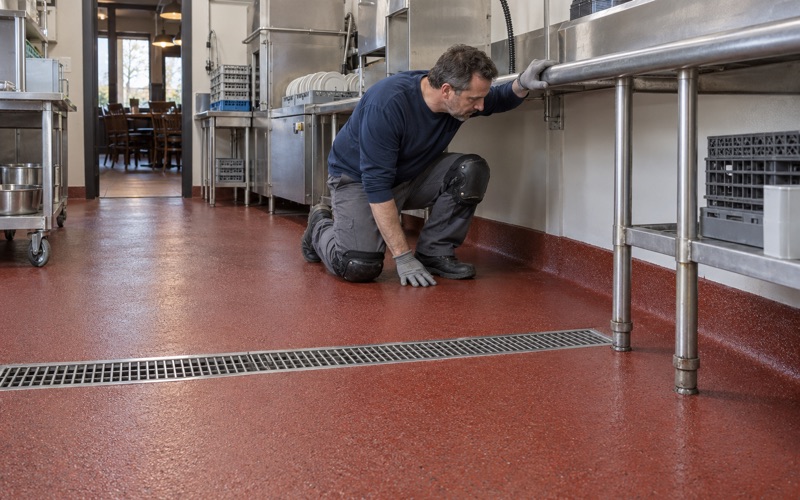
Section 111.20(d)(1)(ii) asks that fixtures, ducts and pipes not contaminate by dripping, other leakage or condensate. That is an equipment duty, but the floor under a chilled line lives with the result. Steady drip in one spot keeps the surface wet, carries residue and finds any weak edge in the coating.
We map those drip zones before installing and give the bond and topcoat extra attention there. If a pipe is dripping constantly, we say so, because fixing the source protects the floor better than a thicker coat. The system is chosen to tolerate occasional condensate, not to excuse a leak.
Cure Against Dew Point, Not the Calendar
Curing is scheduled against slab temperature and the dew point spread at the slab surface. In a room held cool for production, the concrete can sit close to the dew point, and resin laid on a damp surface can develop amine blush or lose adhesion. We take those readings before we mix, and we postpone when the numbers say to.
New Industrial Space and Pole Building Slabs
Corporate Park, DeBack Farms and South Hills
The village is adding industrial space quickly. Zilber Industrial 2, a 142,560-square-foot building at 4300 Carly Avenue, sits in Caledonia Corporate Park, and DeBack Farms Business Park carries a 188,000-square-foot spec building. Ashley Capital is converting the former South Hills Country Club, about 220 acres, into 10 buildings totaling roughly 3.8 million square feet.
A new slab in one of those buildings is not automatically ready for a coating. Fresh concrete has to give up its water, and a spec building may sit empty before a tenant chooses a use. We test once the tenant’s process is known, because a clean production room needs a different build than dry storage.
Pole Buildings 250 Square Feet and Up
For homeowners, the village rule that matters is simpler. An accessory structure or pole building of 250 square feet or larger must sit on a concrete slab, any structure of 36 square feet or more needs a permit, and a plat of survey is required at 400 square feet. With 79 percent of Caledonia’s housing units being single-family detached homes, plenty of those slabs become workshops and vehicle storage.
A pole-building slab is often unheated and may have been poured without a vapor retarder, so we test it the way we test a garage before any coating is quoted. Floors that take road salt and calcium chloride brine off a truck’s tires get a system built for it. When an unheated building is too cold to cure a coating properly, we tell you it has to wait for spring.
Permits and the Village Building Department
Wisconsin issues no license for floor coating work, so we confirm with the Village of Caledonia Building Department whether a permit applies before a job is scheduled. The department is staffed in-house with a senior building inspector and a building inspector, and its requirements cover new commercial buildings, dwellings, additions and alterations.
Every home job also gets a written contract before any deposit, as Wisconsin’s ATCP 110 home improvement rule requires, with the products and any warranty written into it. Grinding dust and slurry are collected on site and never rinsed toward a street drain or Lake Michigan. That holds on a pole-building slab and a plant floor alike.
- 20+ Years on Concrete
- Moisture Tested First
- Written System Proposals