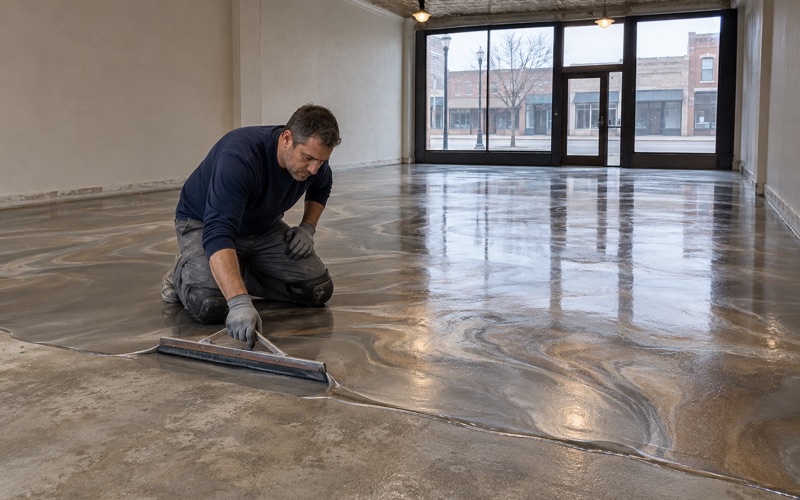
Kenosha Epoxy Flooring has spent more than 20 years installing epoxy flooring in Beach Park and on both sides of the state line, and the jobs that teach us the most are the ones where a floor has to do more than look clean. A shop slab that doubles as a rinse pad is one of those. It gets wet on purpose, often and under pressure, and the coating on it has to hold up to that routine rather than to an occasional spill.
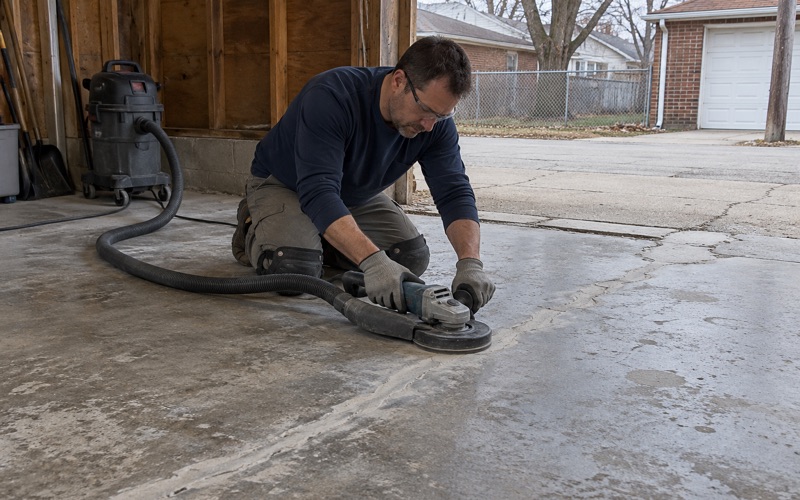
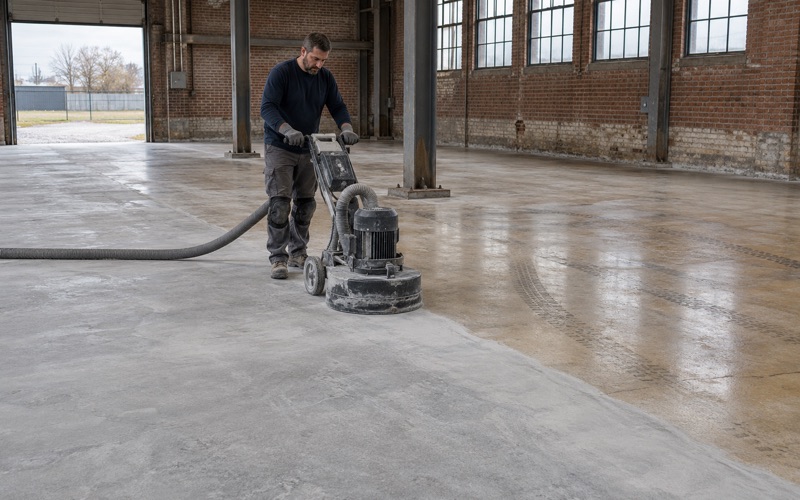
Our approach starts at the concrete. Every slab is opened with a diamond grinder or a shot blaster before any primer touches it, and we never acid etch. Moisture testing is written into the scope as its own line, so a slab that is pushing vapor gets found before the coating goes down, not after it blisters.
The proposal you sign names the product, the system build and the finished thickness. That gives you something to check against the floor once it cures, and it gives anyone reviewing the shop later a clear record of what was installed and to what depth.
Lawn Crews in Beach Park and the State Containment Rule
Landscapers and a golf course on the village list
The Village of Beach Park keeps a business directory of 69 businesses, and three of them are landscaping services: Bart’s Landscaping on Wadsworth Road, Ivan’s Landscaping on Lewis Avenue and Ruben’s Landscaping Services, also on Wadsworth. Greenshire Golf Course on Lewis Avenue is on the same list. It is a short roster, but it is real turf work in a village of a little over 14,000 people.
We have not checked which of these businesses applies pesticides, and we do not assume any of them does. What we can say is that a turf operation that mixes, loads or rinses pesticide equipment in Illinois falls under a specific state rule, and that rule has a lot to say about the floor under the work.
What 8 Ill. Adm. Code Part 256 covers
Part 256 of Title 8 of the Illinois Administrative Code governs lawncare containment areas. It applies to areas used to capture spills or to wash and rinse pesticide residue from vehicles, application equipment, mixing equipment, floors and other items used on closely mown turf or turf with trees and shrubs. It also reaches areas used to load lawncare products for distribution.
The permits themselves come from the Illinois Department of Agriculture, not from a flooring contractor. A coating does not make a pad compliant, and we never describe one that way. Our job is narrower: build a surface that stays sealed under the use the rule describes, so the operator’s own permit work has a sound floor beneath it.
An impervious containment area, in plain terms
Section 256.40 requires the containment area to be constructed of impervious materials. Bare concrete is porous, and a slab that looks solid can still wick liquid into its capillaries and hairline cracks. A continuous resin film over a properly profiled slab is one common way to close that surface off, provided it goes down thick enough and free of pinholes.
That is why we read the cracks, joints and any old coating before quoting. If a slab is too broken to carry a continuous film, we say so and recommend repair or replacement first. A coating follows the concrete beneath it, and it will not stop movement the slab itself has not stopped.
Looking for epoxy-flooring closer to Racine? See Racine Epoxy-Flooring.
Impervious, Curbed and Sumped: Building the Pad
Permit classes and what changes between them
Part 256 sorts its general permits by size. Class A and Class B cover operations handling up to 100 gallons or 100 pounds, and Class C covers larger ones. Class B and Class C pads must have a curbed area and a sump, and a Class C pad must hold at least 120 gallons or 120 percent of the largest applicator tank.
Those numbers belong to the operator and the department to work out. What they mean for us is geometry. A curb has to tie into the floor without a seam that leaks, and a sump has to be coated inside and at its rim so liquid that collects there stays in the containment.
Coating the curb and the sump
A curb poured onto an existing slab creates a cold joint along its base, and that joint is the first place a pad tends to fail. We grind both surfaces to an ICRI CSP profile suited to the system, fill the joint with a semirigid filler, and run the coating up the curb face and over its top so one continuous film runs from field to edge.
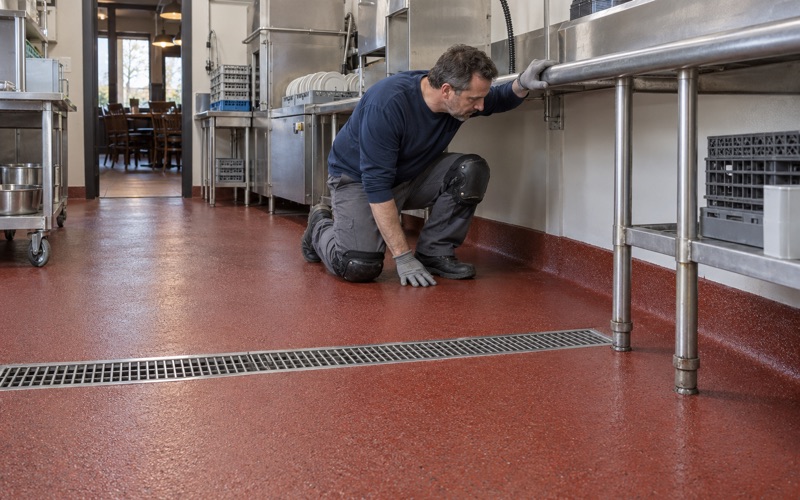
Inside a sump, the coating sees standing liquid, grit and the scrape of a pump intake. We build those surfaces with 100% solids epoxy at full film thickness and detail the rim where the floor slopes in, since that transition takes the most wear from squeegees and hoses.
Testing before the slab is closed off
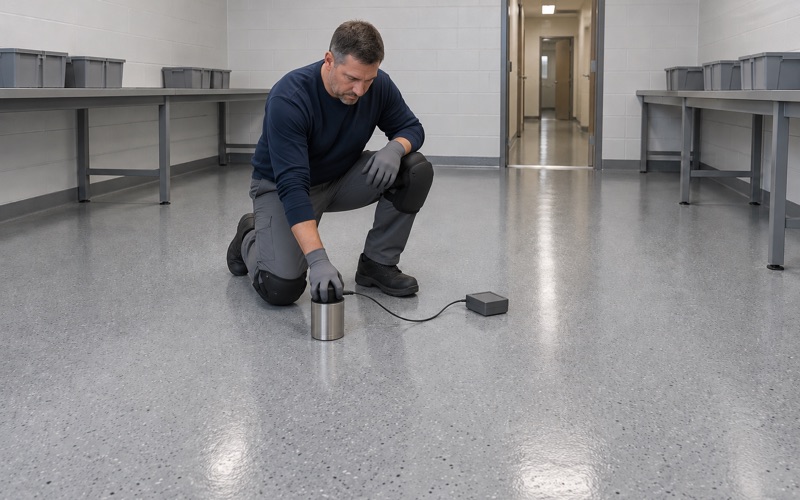
An impervious film laid over a damp slab traps vapor underneath it, and that is the classic path to blisters. On a shop slab we run ASTM F2170 in-situ relative humidity probes or ASTM F1869 calcium chloride tests as conditions call for, and we specify a moisture-mitigation primer where the readings require one.
Moisture is the first warranty exclusion we name, and we read every exclusion out before the job is sold. Curing is scheduled against slab temperature and the dew point spread at the surface, so an unheated shop in late fall may simply have to wait for warmer weather. We would rather say that up front than lay resin on a slab that cannot cure it.
Triple Rinsed With a High-Pressure Hose
What Section 256.70(b) asks of the operator
Section 256.70(b) states that pesticide spills into containment areas shall be recovered promptly, and that the areas shall be washed with a biodegradable cleanser and triple rinsed with a high-pressure hose. Uncleaned spray equipment is parked in the containment area as well, so the floor sees drips and residue between washes, not only during them.
That routine is the real test of the floor. A single spill on a garage slab is an event, while a rinse cycle repeated after every spill, season after season, is a duty cycle. We size the system for the duty cycle rather than for the event.
Pressure washing and film integrity
A high-pressure stream finds every weak edge. It lifts a coating at an unsealed termination, drives water under a loose flake and wears through a thin roll-on paint quickly. A resin system bonded to a ground slab, built to a stated thickness and finished without voids, stands up to repeated washing far better than a film over smooth, unprofiled concrete.
We generally build these pads with a 100% solids epoxy base and a polyaspartic or polyurea topcoat, and we can add a quartz aggregate broadcast for footing. The proposal names each layer and the finished thickness, so the operator knows exactly what sits under the containment.
Cleanser, residue and footing
Because the rule calls for a cleanser on every wash, we ask which product the crew uses and check it against the topcoat maker’s chemical resistance data before we specify the system. A topcoat chosen without that step is a guess.
Footing matters on a pad that is wet by design. A smooth gloss epoxy turns slick under water and soap, so a broadcast texture is usually worth the slightly harder cleaning it brings, especially where crews carry tanks and hoses across the floor.
Rig Parking, Rinse Water and Where the Rule Stops
Fertilizer-only shops and home garages
Part 256 excludes containment used only for fertilizer, and it excludes structural pest control containment too. A landscaping shop that stores and loads fertilizer alone sits outside this rule, and we would not tell an owner otherwise. That shop may still want a sealed floor for cleanup, but the reason is housekeeping rather than a state containment requirement.
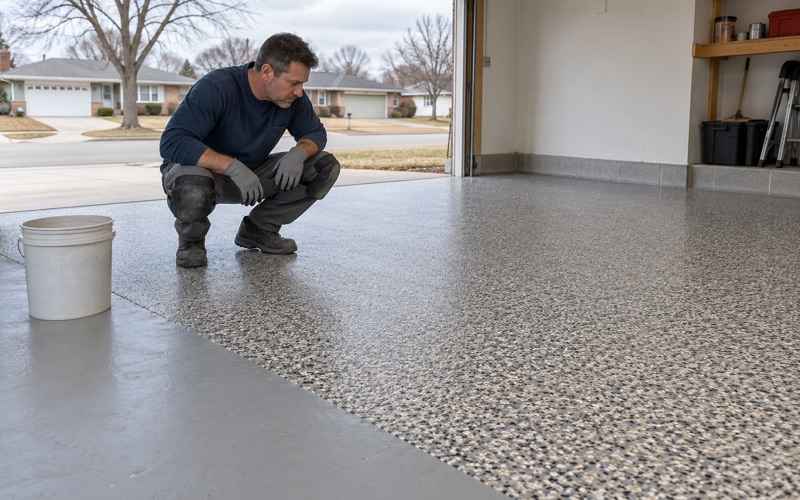
A home garage in Beach Park is not a lawncare containment area either. For a homeowner we still test moisture and grind the slab first, then build the floor for the road salt and calcium chloride brine a Lake County winter tracks in. Because the job sits in Illinois, the coatings we apply also have to meet the state’s VOC limits under 35 Ill. Adm. Code Part 223.
Rig parking in a Beach Park shop
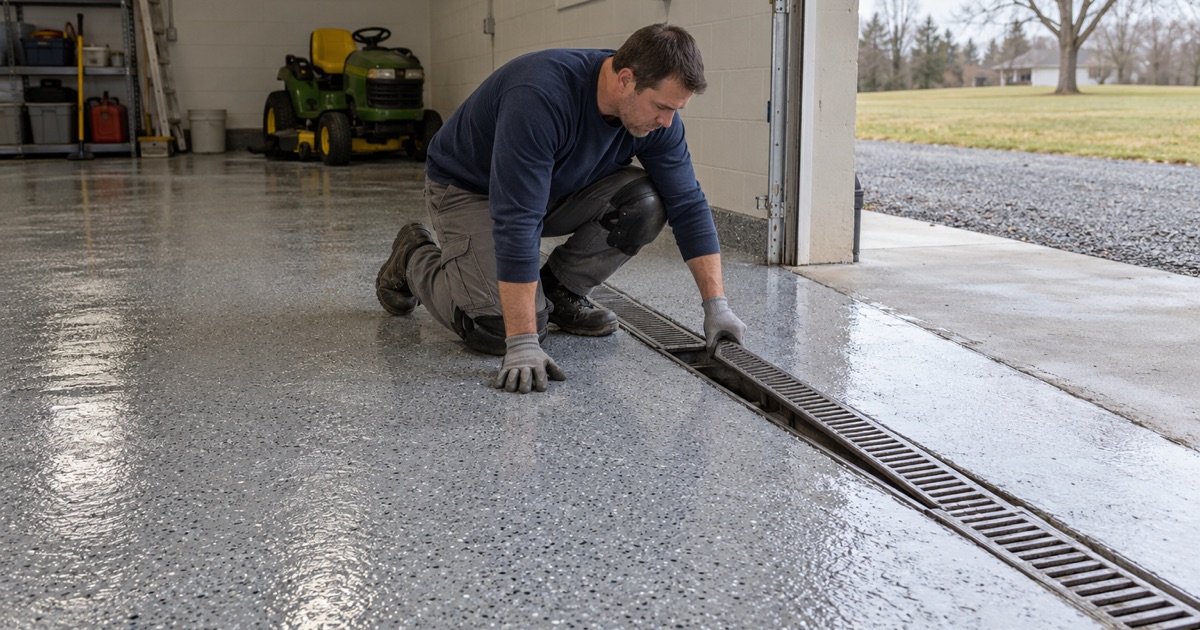
A rig parked on the slab drips from tanks, booms and tires, and in winter it brings in brine as well. Where heavy tires sit on a warm floor, the topcoat also has to resist hot tire pickup. We give parking lanes the same full build as the containment area, so the two parts of the floor do not age at different rates.
Before we schedule any curb or sump work, we confirm with the Village of Beach Park’s Building and Zoning office whether it needs a building permit. Illinois licenses no flooring or coatings contractor, so the village is where that question goes, while the containment permit itself stays with the operator and the Department of Agriculture.
Grinding slurry, rinse water and the storm sewer
The village runs a stormwater program under its NPDES Phase II MS4 permit, with illicit-discharge reporting through Public Works. Grinding dust and slurry from our preparation are collected on site and never washed toward a street drain, and the same goes for any water we use during the job.
Once the pad is in service, rinse water from containment belongs in the sump, not out the overhead door and down the driveway. A curb that holds and a sump coated tight are what keep it there, and that is the practical point of building a Beach Park shop floor this way.
- 20+ Years on Concrete
- Moisture Tested First
- Written System Proposals