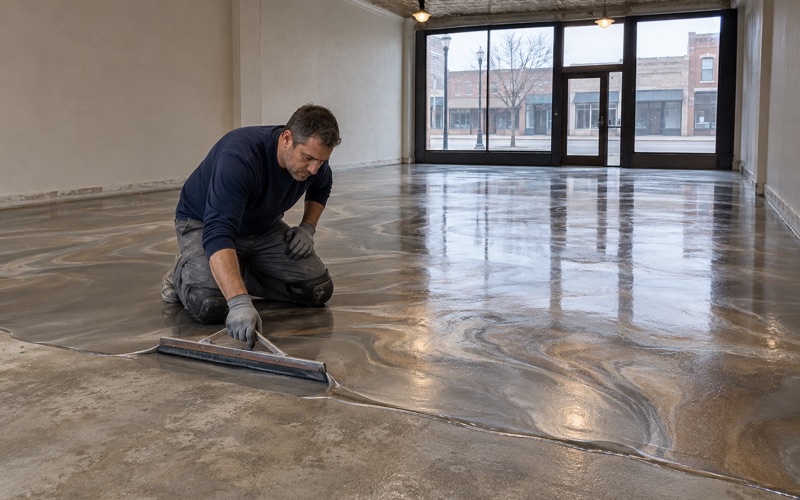
Kenosha Epoxy Flooring brings more than 20 years to epoxy-flooring in Antioch, and the floors we are asked about most here are production floors where small plastic parts get made. On that kind of floor a coating is judged less by how it looks than by what happens when something small and round lands on it. We build the system around that question first, then choose the product.
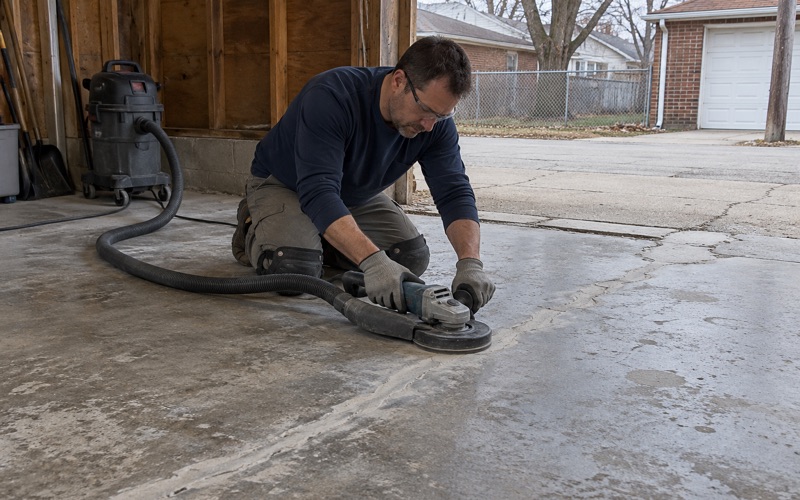
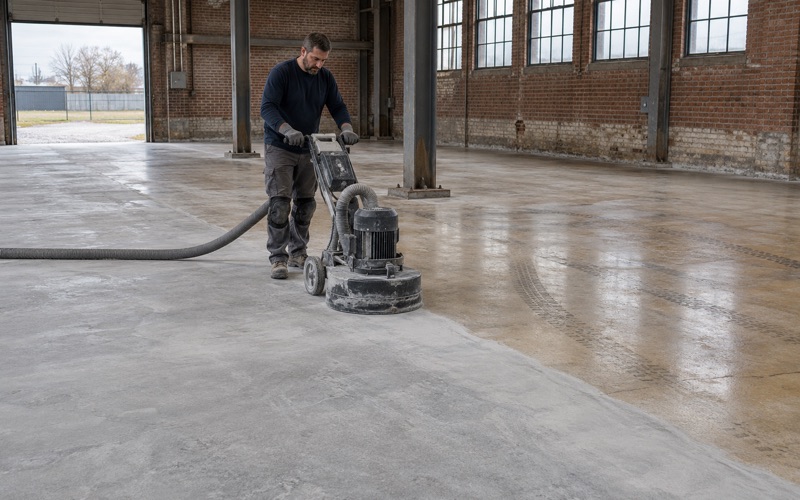
Every slab we coat is opened mechanically with a diamond grinder or a shot blaster, never acid etched, so the profile can be checked against the ICRI CSP chart. Moisture testing sits in the scope as its own line item. The proposal names the product, the system build and the finished thickness, which gives a plant manager a document to hold against what actually went down.
We also read the cracks, joints and any old coating before we price anything. If a slab needs repair before it can carry a film, we say so up front, along with the plain fact that a coating follows the concrete under it rather than holding it still.
A Medical Molding Plant on Drom Court, and Where Its Pellets Land
What runs at 606 Drom Court
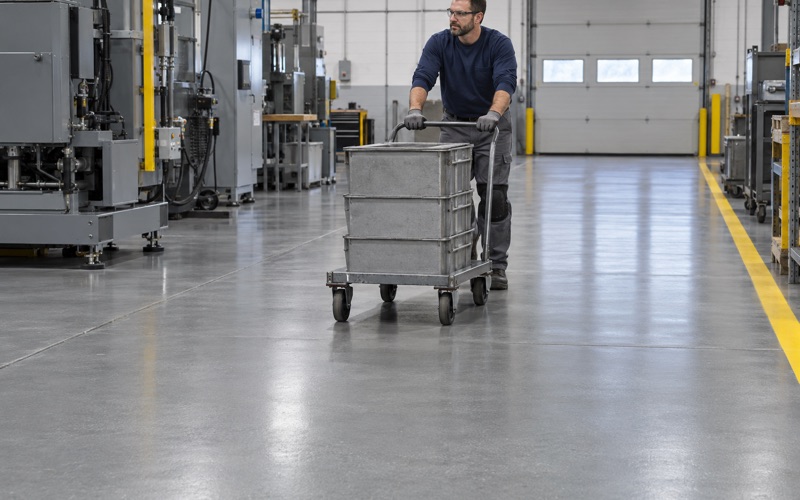
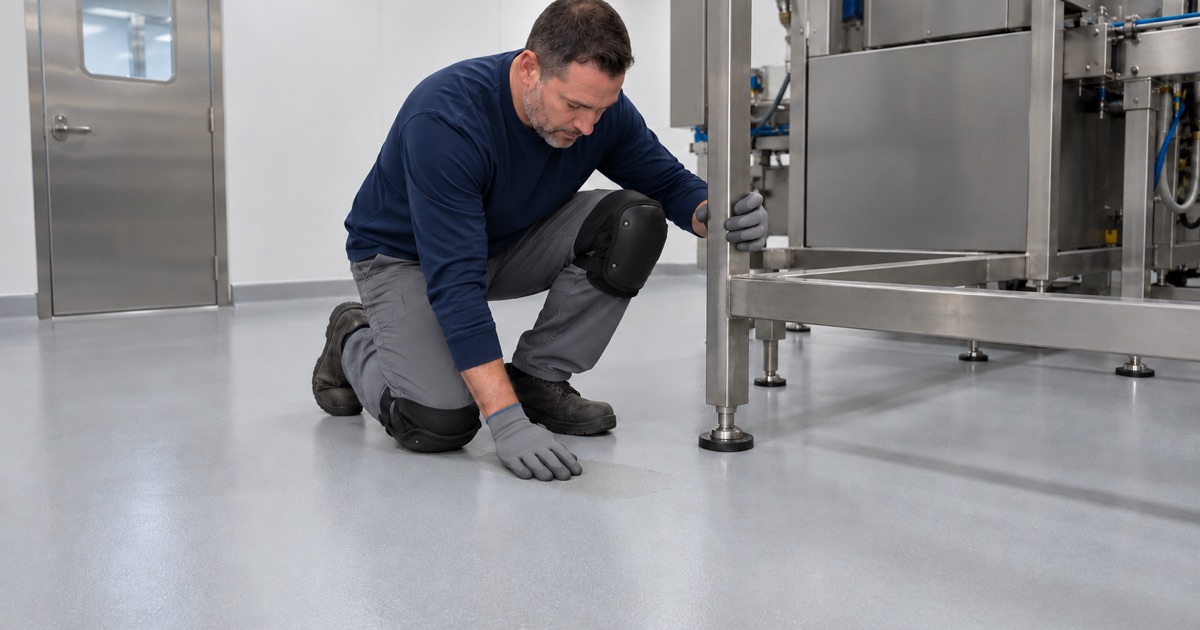
Westfall Technik at 606 Drom Court is a medical injection molding plant that makes diagnostic components and labware inside the village of Antioch. Its own published figures list three Class 8 cleanrooms with ISO 13485 certification, a GMP white room, and 15 injection molding machines of 55 to 280 tons with room for more than 30. We have not worked or inspected those floors; we use the plant as the clearest local example of the floor type this page is about.
The building has a history on the same footing. It began as All West Plastics, ran under MGS Mfg. Group from 2006 until it closed in 2020, and sat empty for over a year before Westfall took it from a vacant shell to full production in six months. A building that has changed hands that way is exactly the kind where we read old coatings, patches and anchor holes before quoting anything new.
The auxiliaries around each press
A press cell is more than the press. Dryers condition the resin, material loaders pull it up from bins, gravimetric blenders meter in colorant or additive, and granulators chop sprues and runners into regrind that goes back into the hopper. Each of those handoffs is a place where material escapes onto the slab.
Resin pellets and regrind are the everyday spill on this kind of floor. A pellet is small, hard and nearly round, and on a smooth, glossy coating it behaves like a ball bearing under a shoe. Regrind is flatter and sharper, so it tends to lodge rather than roll, which makes it a sweeping problem more than a slipping one.
Mapping the floor before we price it
On a molding floor we walk the line with whoever runs it and mark where material moves: loader hoses, blender stations, granulator discharge and the path from dryer to feed throat. Those zones need the most texture and the most care at the base of each machine. The open walkways between cells can often carry a finer finish.
The same map shows where a press base, a conduit run or a floor-mounted auxiliary sits on the slab and has to be worked around. Coating up to a fixed machine foot is detailing work, and we price it as detailing work rather than pretending the floor is an empty rectangle.
Looking for epoxy-flooring closer to Salem Lakes? See Salem Lakes Epoxy-Flooring.
Texture That Grips Without Trapping Pellets
Why a gloss finish fails here
A smooth 100% solids epoxy with no broadcast is easy to mop and hard to stand on once pellets are down. The fix most garage floors get, a heavy vinyl flake broadcast, creates its own trouble around a press, because deep texture holds pellets and regrind in its valleys where a broom skips over them. A press floor has to grip a boot and still give up loose material to a sweep.
That balance is where we spend the most time in a molding plant. Too little texture and pellets roll underfoot; too much and the floor turns into a pellet trap that looks clean from across the room. Neither outcome is fixed by a better cleaning crew, so we settle it in the system design.
Quartz aggregate and a sealed topcoat
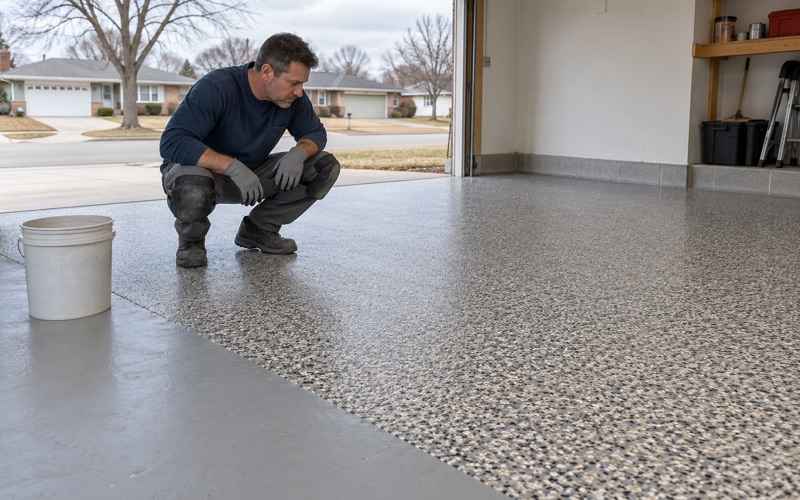
Our usual answer on a press floor is a fine quartz aggregate broadcast into the epoxy, then locked down with a topcoat so the peaks are rounded rather than sharp. Grit size and the number of topcoat passes set how aggressive the surface feels. We put sample boards in front of the people who actually sweep the floor before anything is chosen.
A polyaspartic or polyurea topcoat is often part of that build because it lets the texture be tuned with a thinner film. Whichever we use, the written proposal states the product, the aggregate, the system build and the finished thickness. The texture the plant approved on a sample board is then the texture that gets installed.
Grading texture by zone
Texture does not have to be uniform across a plant. We can run a coarser profile in the zones flagged around loaders and granulators, step it down in open walkways, and keep a smoother finish where parts carts and bins roll. Each change is drawn on the floor plan before the job starts, so nobody discovers a boundary on install day.
Joints and cracks matter here too, because a pellet that finds an open joint stays there. Joints are filled with a semirigid filler before coating, and cracks are read and repaired rather than bridged with a film that will simply follow them open again.
Cleanrooms and White Rooms: The Plant’s Rules Come First
Who decides what happens in a classified room
Westfall’s three Class 8 cleanrooms run under the plant’s ISO 13485 quality system, and the GMP white room beside them is fully climate controlled. Whether a coating crew can work inside either one, when, and with which materials and controls, is a decision for that quality system and the plant’s own people. It is not a call a flooring contractor gets to make.
We say that plainly because no coating carries a cleanroom certification on its own, and none holds an ISO rating or an FDA approval. What we can supply is product data sheets, cure schedules and a written work plan for the plant to weigh against its own procedures. The answer to that review is theirs.
What we bring to that conversation
If a plant does schedule floor work in or beside a controlled room, our part is planning the sequence. That means grinding dust collected at the grinder, every material named in writing, and a cure scheduled against slab temperature and dew point rather than a date on the calendar.
It also means working around production. A molding plant has hours it has to keep running, so we use overnight and weekend windows and phase the floor cell by cell when the plant asks for it. Each phase is closed off, cured and handed back before the next one opens.
Moisture before any of it
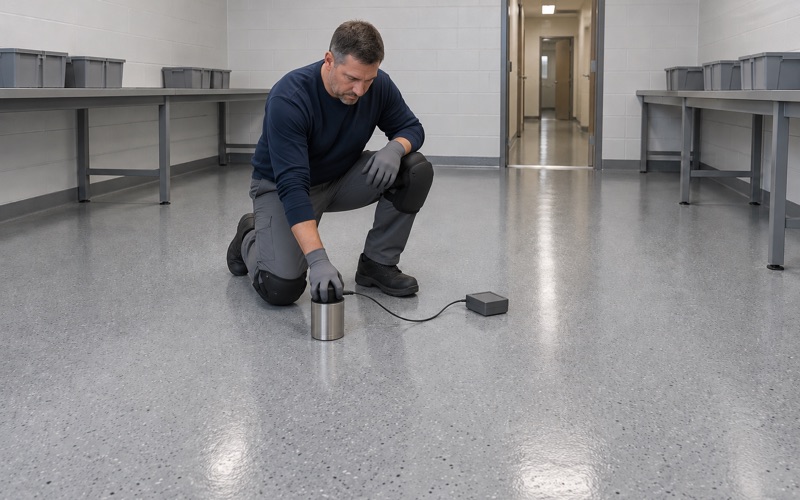
None of these coating decisions hold if the slab is pushing moisture. We test with ASTM F2170 in-situ relative humidity probes or ASTM F1869 calcium chloride kits and compare the readings with the product’s own limits. If the numbers run high, a moisture-mitigation primer goes into the system before any build coat.
Moisture is also the first exclusion we read out of the warranty, before the job is sold rather than after a floor blisters. A plant that knows the exclusions in advance can decide on mitigation with its eyes open.
What OSHA’s Walking-Surface Rule Asks of an Antioch Molding Floor
The text of 29 CFR 1910.22
OSHA’s general industry rule at 29 CFR 1910.22(a)(1) says places of employment, passageways, storerooms, service rooms and walking-working surfaces are kept in a clean, orderly and sanitary condition. Paragraph (a)(3) adds that walking-working surfaces are maintained free of hazards such as sharp or protruding objects, loose boards, corrosion, leaks, spills, snow and ice.
Spilled resin pellets around a press are exactly the kind of spill that paragraph describes. The rule names a condition the employer keeps, not a coating type, so no floor product satisfies it simply by being installed. What a well-chosen floor can do is make that housekeeping easier to keep up shift after shift.
How the floor supports housekeeping
A floor that sweeps clean, shows a dropped pellet against its color and has no open joints for material to hide in is a floor a crew can keep orderly. We pick a color with enough contrast for spilled pellets to stand out, and we cove the base where walls meet the slab so a broom has nowhere to stop.
The floor also has to stand up to the cleaning it will get. A topcoat that holds up to daily sweeping, scrubbing and the plant’s own cleaners keeps its texture longer, and we name the maintenance it needs in the proposal rather than leaving that for later.
Permits and site practice in the village
The Village of Antioch Building Department and Community Development office, at 847-395-1000, publishes commercial permit applications and project supplements. Illinois issues no license for flooring or coating contractors, so we confirm with the village whether a given job needs a permit before it goes on the schedule.
Antioch sits on the Chain O’Lakes waterway system in Lake County, against the Wisconsin line and roughly halfway between Chicago and Milwaukee. That water is one more reason our grinding dust and slurry are collected on site and never washed toward a floor drain or a street. On a plant floor, it also keeps the press cells cleaner while the work is underway.
- 20+ Years on Concrete
- Moisture Tested First
- Written System Proposals